@panixia Yes as war itself.
Image 1 larger on this link https://zupimages.net/up/26/18/cu6v.jpg
Here is my representation of the Horseman of the Apocalypse: Death.
The image is deliberately in black and white. Colour belongs to the living. Here, everything is already fading. The smoky environment is not a setting but a zone of indeterminacy: the moment of passage. Death does not last. Unlike the other three horsemen — famine, pestilence and war — which are inscribed in time, Death is a point. A tipping point. And yet, it is the most powerful.
The rider himself remains enigmatic. Flayed, without an identifiable head, he may not be Death, but only its vector. We think we see Death approaching, but we never really know it.
Beneath the horse winds another presence: an umbilical cord attached to a skull. This creature, both organic and macabre, could be the real Death. It evokes a continuity between birth and disappearance, like an uninterrupted flow rather than an isolated event.
This idea originated in a visit to the Poggi Museum in Bologna. In the room of the flayed, the anatomy exposed in its brutality served as a direct reference for the body of the rider. In the next room, representations of uterus and foetuses, as well as a glass object depicting a pregnant uterus resting on truncated legs, triggered another lead: that of death as a reverse birth. This item became the base of the rider's helmet. The legs have been removed to keep only the essential shape, transformed into a closed helmet.
The saddle has been voluntarily removed. I ruled out the option of a decorated saddle, too legible, and that of a shroud-type fabric, too expected. Instead, a simple hollow in the frame. This accentuates the strangeness and transforms the horse into a support, almost an object.
The horse itself is treated minimally. Its tail disappears into the shadows — the past — to suggest that Death has been present from the beginning. Her head is partially engulfed in darkness: it is not known where she is going, or who will be hit next.
Above the rider, a cone of light cuts through the scene. It can be interpreted as a divine presence. If God exists in this image, he is perhaps the only one who knows what Death really is and what his purposes are.
The horseman's weapon extends this logic. The scythe was modeled from an AI-generated image according to my instructions and then reworked. An unexpected symbol has appeared on its blade: an on/off pictogram. I kept it and merged it with the letter Omega to create a sign specific to this entity. This symbol condenses a complete cycle from left to right: pregnancy, birth, life, death (in its luminous phase), decomposition, and then recomposition into another system.
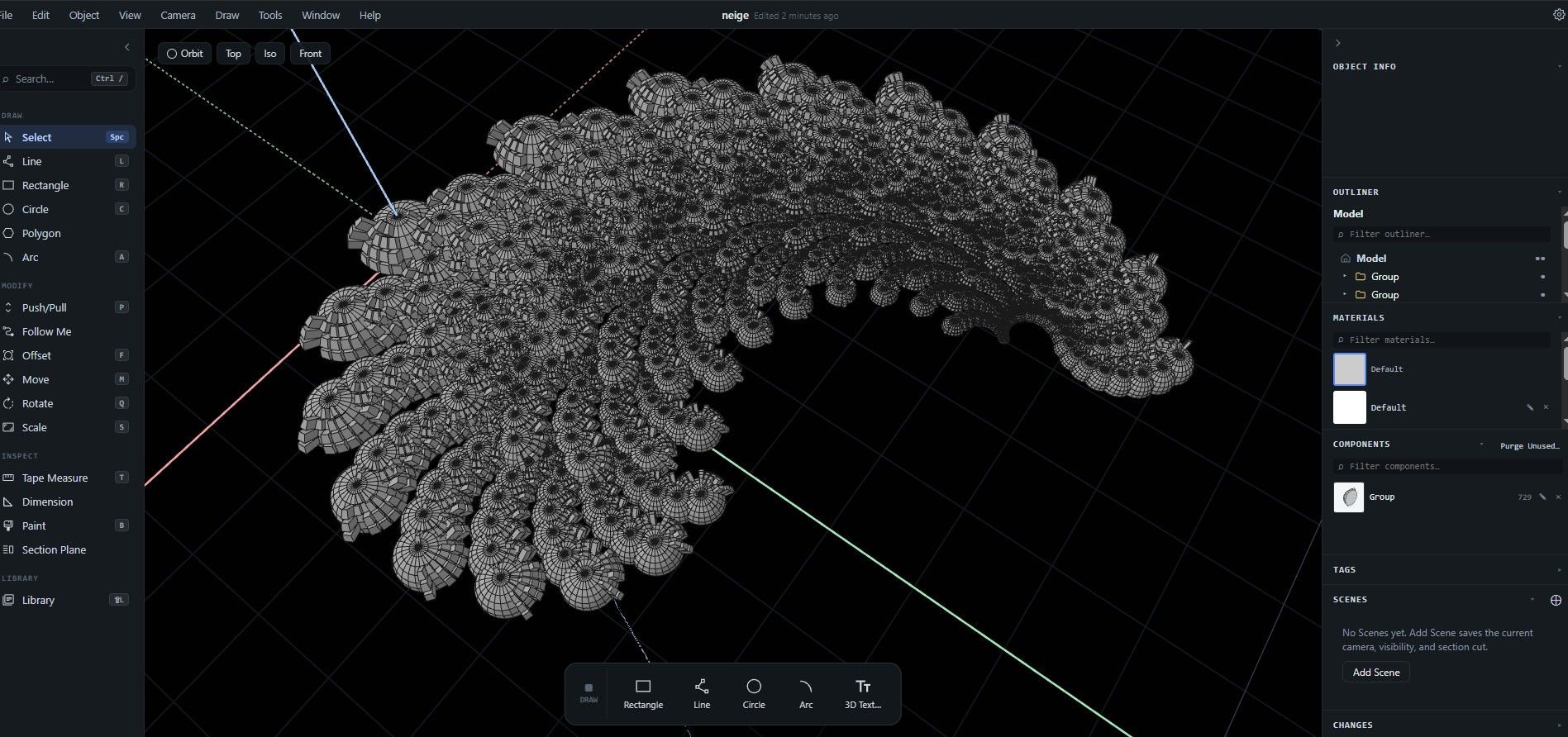
On the technical side, the skeleton was downloaded and then reworked in Blender and ZBrush. The horse was modeled in SketchUp from an AI-generated database and then refined in ZBrush and Blender. The scythe follows a similar process, between assisted generation and manual reconstruction.
The whole does not seek to tell a scene, but to set up a system. Death is not a spectacular event, but a discreet, inevitable mechanism already at work.
Images of the references at the end.
AI text
[image: 1777476692069-p01.jpg]
[image: 1777476710013-p02.jpg]
[image: 1777476719763-p01.jpg]
[image: 1777476724949-p02.jpg]
[image: 1777476732117-p03.jpg]
[image: 1777476741879-p04.jpg]
[image: 1777476760025-p05.jpg]
[image: 1777476766737-p06.jpg]
[image: 1777476771400-p07.jpg]
[image: 1777476776297-p8.jpg]
[image: 1777476849983-p9.jpg]
keyScythe
[image: 1777476869101-p.jpg]
[image: 1777476873889-symbole.jpg]
[image: 1777476886366-fauxcle.jpg]
references
[image: 1777477110935-resizedfaux.jpg]
[image: 1777477121272-resizedtoutcheval.jpg]
[image: 1777477197468-resizedtoutcasque.jpg]