
It is my intention in this series of posts, to bring the budding designer along with me (also a 'noobie') on a journey of growth. I have always used the most basic and primitive tools in the design process. A few notes and drawings scratched on paper, detailing an idea whose fruition was most often preceded by a wasteful and prolonged period of trial an error. SketchUp has provided a means of avoiding all that. It has been a wonderful gift and a superb learning experience.
I would like to take a moment to thank the good people at Trimblefor providing a non-profit license for SketchUp 2015 Pro. It has been an interesting learning process, but ultimately very fruitful. Without SketchUp, I would not have been able to avoid all the pitfalls normally associated with my former methods. Special thanks to the membership here at SketchUcationfor sharing their hard-won experience and skills. I am indebted to you all. I invite everyone to offer suggestions and corrections as I am still just learning to crawl.
To continue with this project: The drawbacks to my current survival shelter model are both simple and profound. Every human has wants and needs that should be met. In order to properly address these issues, the following must be incorporated into the design process for a viable survival shelter within the context of the profoundly poor and disenfranchised to be realized:
- Security
- Portability
- Durability
- Flexibility
- Environment
- Facility
There are limits to what I can do. But to consider these necessities with my limitations in mind, I can still make progress.
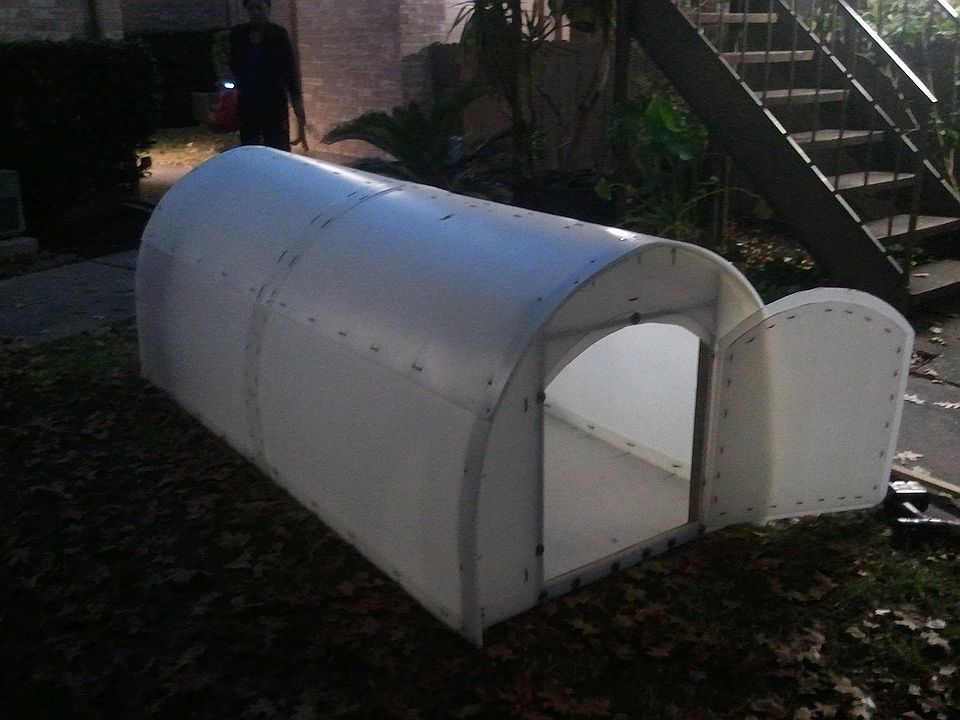
Last year I was given some Coroplast in 4'x4' sheets. I acquired some screws, tape, tie-wraps and decided on a project. The results are detailed above. Herein I am attempting to address what I have learned.
Security
These people have very little and no place to keep it. Every day they start with what they can carry. The answer is to give them somewhere to keep their belongings and a means to secure them.
Portability
A transient lifestyle require that their resources be portable. Should they gain employment, no matter how temporary, they must be able to respond without concern for their belongings and their place of shelter. The answer is to bring it all with them.
Durability
The shelter must be able to withstand daily use while providing protection for their meager possessions and comfort and practicality for them.
Flexibility
The shelter must be able to meet their needs in an ever changing environment. Where they are welcome of at least unmolested one day, may change without notice. They must be able to move and re-establish camp with a minimum of time and effort.
Environment
Controlling humidity and temperature are crucial to comfort and health. But they are also crucial to storage too. Both perishables and non-perishable items can be damaged or ruined without environmental considerations. A means must be provided to address these issues.
Facility
The normal day-to-day needs that we take for granted are often denied to the homeless population. A place to bath, wash clothes or use the restroom are not guaranteed. The facility to accomplish normal daily needs should be included in the design process.
In a final note, I am far from wealthy. So the design process must accommodate my limited resources too. With this in mind, my solution to a utilitarian survival shelter for the homeless is inspired by the trend toward 'Small Houses'. But my effort will be towards an Ultra-Light, Micro-Miniature Small House on Wheels. Stay tuned...

 Hellnbak seems to be at his wit's end and I'm sure he would appreciate any suggestions you might offer.
 Hope this helps.