Seems reminiscent of the past Jim ... at least the basic idea ... I remember you felt SU menus could be improved in this way ... maybe more
 C
Offline
C
Offline
Seems reminiscent of the past Jim ... at least the basic idea ... I remember you felt SU menus could be improved in this way ... maybe more
Is this really the most user friendly term Google could use with the Chrome browser? Some on-going legal communion initiative? Or just the present intuitive?
I see that you are progressing well with the "technology" side of csv data storage but I wonder (because I am interested in alternative methods) how you are coping with the complexity of the information itself.
I have been always wary of csv because I associate it with spreadsheets and though I have tried very hard from the early days of Lotus 123 I have not found a way to use them to "turn" data to cope with its 3D nature.
What I mean by turn is illustrated by the diagram to the left which suggests it is natural to use a cross section to review the number of floors in a building but plan section to review each floor's spaces. I think this is sufficient to demonstrate data is 3d in nature (or perhaps more accurately access to it). The animation I have demonstrated before allows me to cope with it in a 2D UI.
Information that is often presented as schedules - rebar, door, sanitaryware, ironmongery(hardware) and so on - can be dealt with in the same way, but the properties of the real (as opposed to code) objects require a data or backup display so that you can see collections of key/value pairs for editting.
So assuming you agree basically with what I describe, it would be would interesting to see both a UI design and the structure of the csv or hash solution to compare with the UI and Javascript object notation (json) that I currently use.
Cheers!
Thanks all.
I actually also found this specialist in Hong Kong. I hope they will be able to provide images that I can make into textures and hopefully give me a reasonable price for installing their modules. Cheers!
Thanks Joe but I was really looking for something to help explain the use of the flat roof space to the more sceptical. But all info/advice is useful to me ... so thanks again.
Does anyone known of anything like sedum in shallow trays ... the warehouse doesn't really have anything good. Thanks.
@wdbao said:
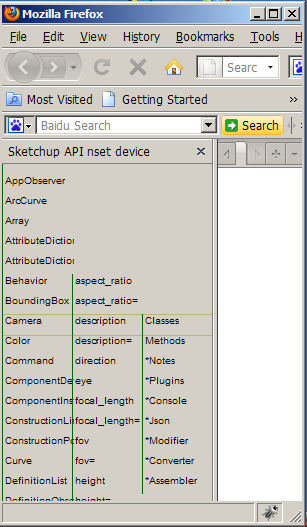
it seems to me that Sketchup Ruby API don't have the CSV library.
should i just use the File class
or should i add the csv module to it
and how?
I used this to collect data from json files (could be csv text files)...
@dlg.add_action_callback("send") { |d, a|
			nr = Integer(a)
			subDir = "nset/"
			files = ["config","nset","mset","words","numbers"]
			lines = []
			file = File.join(File.dirname(__FILE__), files[nr] + ".json")
			File.open(file, 'r') do |f1|
				while line = f1.gets
					lines.push line
				end
			end
			array = [nr,lines]
			array = array.join("qq")
			#p array
			script = "rubyReceive('#{array}')";
			d.execute_script(script)
I don't know what you mean by csv library.
Having worked with people whose mother tongue is not English for 25 years I would use equipment or more specific term as mitcorb notes. "Plant" can be baffling - "you mean narcissus room?"
@box said:
I'm wondering if it is possible to create a "scene tree" (for want of a better term).
Yes it is quite easy to do with a web dialog "machine" - but I am having a lot of difficulty getting my version (Namesets) up to cross platform publishable quality*.
Namesets (see scrapbook or web site) allows the owner to create deep hierarchies of both components and scenes. By circumventing layers (except for dimensions and notes) components can appear in many collections or groupings and can be hidden or shown to create unlimited nested scenes. It also allows cross linking to access data from many different starting points.
If you or anyone else would like to help with this please let me know.
Edit: *I am not a programmer
@gaieus said:
Yes, there are a whole bunch of apps that can display3D content interactively (orbiting, zooming, panning etc. or walk-through like in a FPS game) but you cannot buildthings like in SU and if I understand the original question correctly, it was meant to build (wasn't it?).
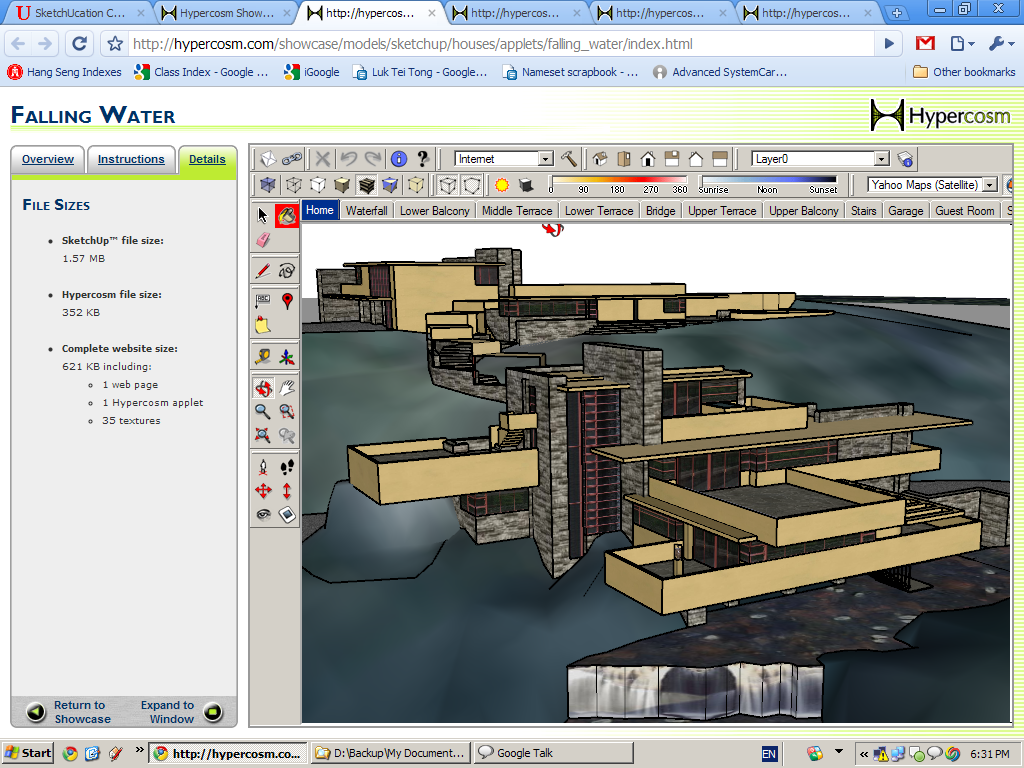
Well it just says workable which is why I asked what he wanted to achieve. From a building viewpoint I see it as workable if were possible to be able to import models of real things and build them collaboratively on a web site. Hypercosm does not allow that right now. But looking at their technical descriptions I think it possible and I have asked them if they think it feasible. Maybe they will reply positively. Will post if so.
@ashscott said:
... perhaps Hypercosm's offerings which you can discover here: http://www.hypercosm.com/
That was what I was thinking might have been meant. I wonder with HTML5 <canvas> it may be possible to manipulate images of Sketchup components directly with small ready made devices rather than heavy purpose-made scripting. Say, for example, a logistics company plans consolidation of the contents of a container by receiving customers' component images and quantities.
@mrgoldfinder said:
Is there a way to put a workable sketchup onto a web page?
Happy Days
If you can define what you want to achieve you might get more optimistic feedback
@sheyue said:
Thankyou,it's a very good big table,l love it.So,I have some collection of Chineses style furniture design by Chinese friend,but I don't known how to publish them.some one chould help me?
Do you mean publish them here?
If so start a new topic called "Chinese style furniture designs" and use the upload attachment device to post a few examples in the first post. It would be a good idea anyway if you want to gather some comments and critiques.
Btw my big table has been ordered and work will start in the Zhongshan workshop in three weeks time.
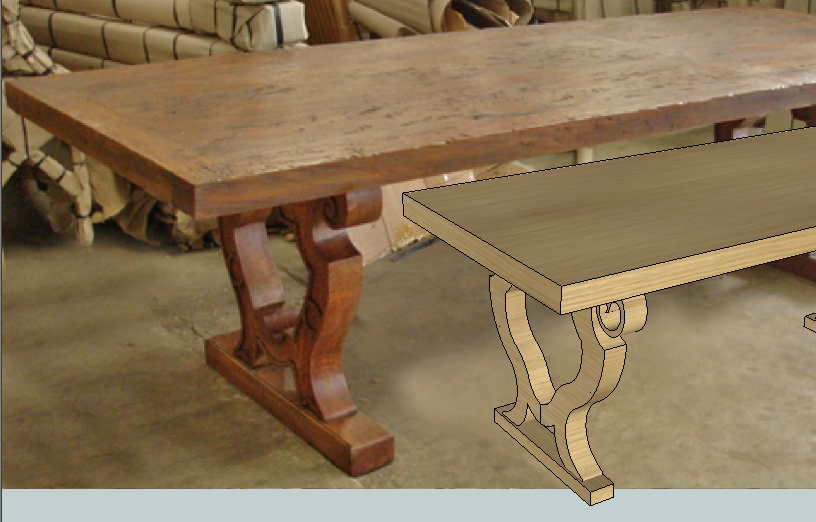
Thanks Box. I have been playing around with your model and came up with this more modestly sized version - 900 x 2000 x 750 high.

@michaliszissiou said:
@unknownuser said:
I'm trying to convince one of my clients to lean more towards SketchUp and Vray
I think what was meant here was more an alternative to Autodesk etc. or perhaps orthogonal drawings in general. This is an extremely important subject if we are ever to reduce the massive and unnecessary amount of paper oriented communication in the building industry and elsewhere. Sketchup models, rendered or not, seem to me to be a good basis for a new modus operandi.
Don't you think?
@regular polygon said:
However, I still feel strongly about having my plugins downloaded from a single distribution point, and the logical place for that is my blog where they are fully documented.
Perhaps this problem can be resolved in the near future another way.
Of course it is up to you but often it is of mutual benefit when similar things from different sources are offered in one place - like a street market, souk or forum.
Thanks a lot for responding so quickly - especially Box with the splendid skp. I am going to try to smooth out the raised parts on the supports to make it less ornate (more farmhouse) and check the sizes. If successful will post the resulting skp and hopefully in due course a photo of the real thing ... n'shala!
Many thanks
Chris
@hieru said:
Are you capable of creating a profile for the legs using a CAD programme or Adobe Illustrator?
If that is possible then you could import the profile as a DWG/DXF file and then simply create the legs with the push-pull tool.
Thanks. I understand how to do it but I am going to the workshop on Wednesday and my Sketchup skills are really rather rudimentary. I always think that the quality of the real thing is influenced by the quality of the model/drawings, so I want to see if there is a way to achieve that.
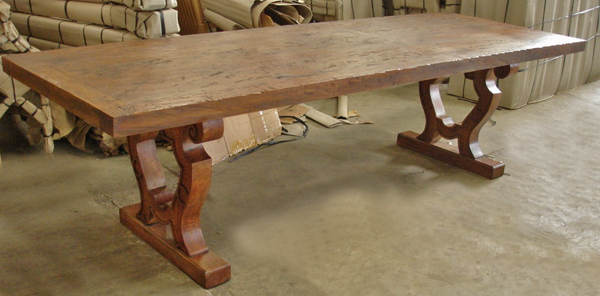
I want to get a table like this made but I want to be able to alter it a bit and make my requirements plain to the non English speaking joinery shop owner. If any one has a skp or knows of a source for something similar please help me. (I have no time right now to learn how to make the curvies - the top I can just about manage!)
Thanks.
Chris