Thanks for the VRAY advice. Are the results from almost all rendering programs roughly equal as they are all working with the same basic math or do you get wild differences in visualization?
In any case, I may give VRAY a try. Thanks for the advise.
Thanks for the VRAY advice. Are the results from almost all rendering programs roughly equal as they are all working with the same basic math or do you get wild differences in visualization?
In any case, I may give VRAY a try. Thanks for the advise.
I had a sheet of blank steel that I photographed at close to the various angles of the various planes. I then cut out pieces and fit them together like a puzzle. Then I would go back and cut out holes, insert threads, airbush reflections and create masks based on the sketchup shadows etc.
I appreciate what you say about the lighting because I am a professional photographer. Many years ago I worked for an A&E firm and traveled the country photographing their projects. I think about the light before I think about the architecture or the product. People ask me about cameras and I answer by telling them about lights.
However I do need to get at least 80% up to speed on Kerkythea. My method has its advantages but speed and conveniience is not one of them. I need to learn KT so the computer can do the repetitive tasks. It is a great program, but I get lost in the interface. Like everything else, I need to bang my head against the rock until the rock breaks.
Instead of working in the comfort zone at the middle of certain disciplines, I like to work on the periphery where diverse disciplines meet. I am a mixed media type of guy as long as it contributes to the final product.
John, That whole thread was quite helpful and especially Paul's thoughts as you suggested. It does not go direct to my original question, but ti does provide some additional perpective on the problem. Very helpful.
Here is another modular fixture that was even more demanding of computer power.
@schreiberbike said:
I can't answer your questions, but Paul Russam suggested a technique using layers where one layer contains placeholders and another contains the detailed geometry. Something like that may help you. His description is near the end of this thread. http://www.sketchucation.com/scf/viewtopic.php?f=22&t=2585&hilit=
It makes very efficient use of memory when you don't need the detail, then you can have the detail when you need it.
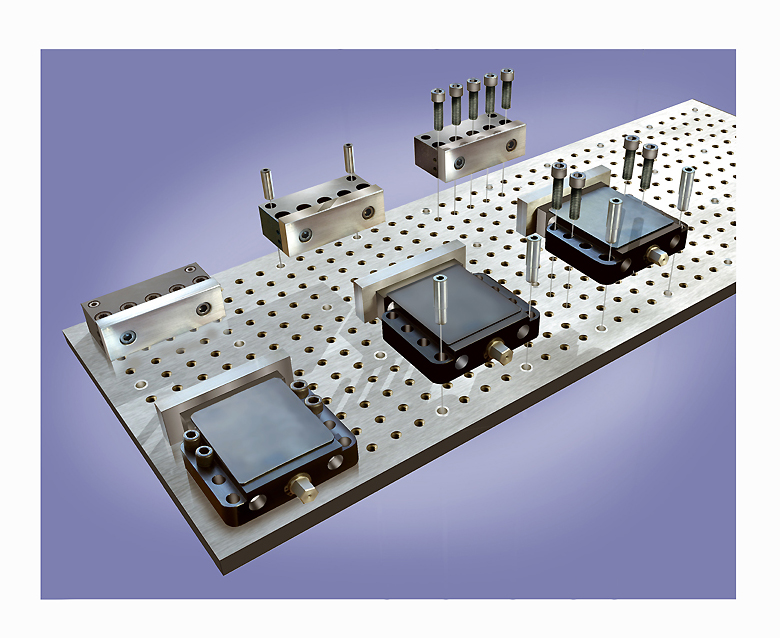
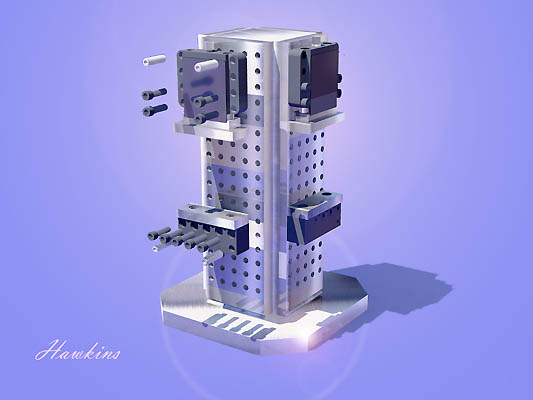
This is a modular fixture that I rendered for one of my clients. These things are incredibly precise. At first I was confused by the clients drawings because everything had two dimensions given. Then I discovered that they work at such insane tolerances that you can't hit the number right on the head when manufacturing so they give upper and lower acceptable limits.
Also screws cannot be used to align parts as they would not turn at the given tolerances. So some holes are smooth for alignment pins and other holes are used to for screws to tighten the assemblies.
This project introduced me to SketchUp/hardware limitations. All of the screw holes had their threads fully modeled. One plate in another drawing had about a thousand holes and most of those were threaded. I finally got to the point where the model would no longer respond.
I ripped out all the threads and just left holes then I photographed an existing plate at approximately the angle that I wanted to render and then using one threaded hole, manipulated the image in photoshop to fit each hole.
My question is can any of you guys tell me what combination of computer capacity and model size causes a crunch where you can not get the model to properly respond.
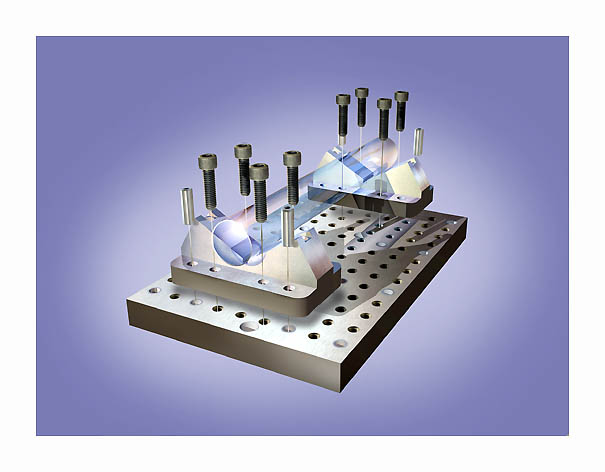
The geometry is 100% sketchup, the rendering is done manually in photoshop. Details like screw threads are photographic overlays. The glass tube is the thin_glass material from kerkythea which I understand the concepts but have not mastered the application (if that makes any sense).
I was having some thoughts along the same lines. My daughter asked me to paint a nural for the new grandkids room. I t is starting to look OK. Then it occured to me to offer mural painting among my services. I thought I can model the rooms in sketchup and even work some renders into freehand sketches so the client can experience the room before putting paint to wall.
Restaurants seem to like murals and I have been to a number where I sit there and think this looks kinda funky I could do better. Maybe not cheaper, but better. Clearly you are ready for the cieling of the Sistine Chapel.
Just foolin around my a.., you are doing good work.

I agree that this represents some advanced modeling skill.  The only thing that jars me is the stone pattern for the top of the well. It should be concentric
  instead of in rows.
Make a habit of reading architectural and interiors magazines and when you see a great photo tear it out and file it. Or even better tape it to a wall. Then when you are facing interior lighting problems take a look at the types of lighting fixtures and the effects. With enough references it should be easy for you to render from the examples.
Here are my thoughts for a slightly different result. It seems like the only light other than the chandelier is SU sunlight entering from the the removed wall or glass front of the store.
Before rendering anything I would figure out how the store is lit. There must be some wall washers or some minispots in the ceiling. And a good lighting designer would hit those paintings with some hidden projector spots with the light maked to stop right at the edge of the frame. All of this would create marketing drama by playing off pools of light against mysterious shadows.
Light can be a more important element than bricks and mortar.
Jewelry is all about sparkle and judicious lighting creates sparkle.
That is my two cents worth on how to improve and already good rendering.
One of my newest components is an entire photo studio. Not needing light stands or power cords is a real luxury.
I just pop the fixture silo into the photo studio, adjust a few lights and we have an image ready for the catalog.
Client saw the final product and his first comment was, "this looks so real maybe we should go back and add the weld beads."
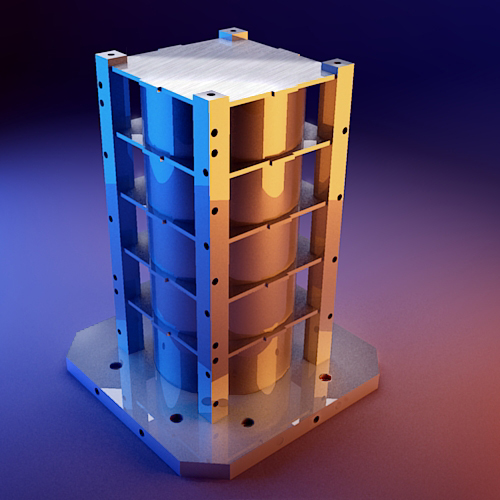
Does anyone know how to turn off a headlight in KT. I can not see it in my list of lights. The white accent is nice but the hard shadow on the cyclorama has to go. I need to bump up the anisotropic scatter to enhance the brushed look. This will also help blend in the reflection of the top light.
Gaieus, I do want to down load the materials but my winzip eval expired. I also have an overflowing toilet which needs to be replaced. Given that choice I have to go with the toilet for now. However you are right life with a good materials lib will be better.
Attachments:
File comment: Bump into enough walls and you figure out the prison is square.
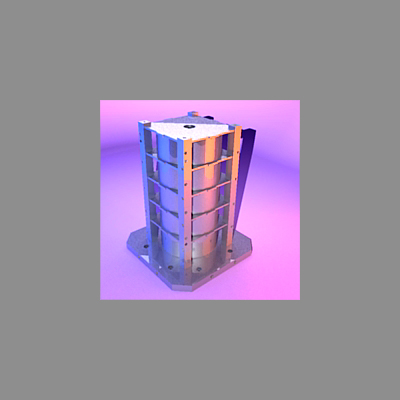
OK, I was able to set up some studio lighting and get a clay model going. Now if I can create a brushed steel look I will be getting close to my goal.
H'mmm the cops are out in force tonight here in Phoenix. Window is open and the Police helicopter is buzzing back and forth.
Anyhow if I get the brushed steel, I can probably drop the light intensity and the whole scene will begin to come together.
File comment: Finally some progress in Kerky.
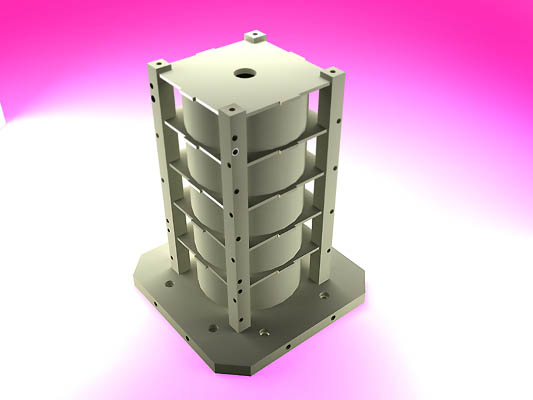
This is a KT rendering gone bad or, perhaps, gone good depending on how you look at it. The whole gadget was meant to be in the final rendering, but I can't figure how to use the KT interface to crop the scene. So this won't work for my client, but as a piece of fine art I love it.
Don't know whether to put in client's brochure or on my wall. Maybe both.
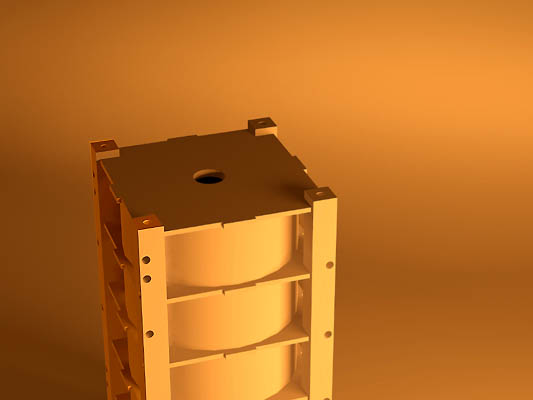
I am beginning to understand KT. It is like climbing Everest. Take a step and breath. Take a step and rest. Get ready to take another step. You think you are there adn then find it was a false ridge and you have to climb another 1000 ft.
I suppose if it ever gets easy I wont want to do it.
Learned a lot of lessons on this one.
Comments and suggestions?
Nicely done. Simple but elegant solution. The remark about the welds must be "irony" as I don't see any welds. I have a project like that in the back yard waiting for me to find some wood. That is a hard thing to find out here in the desert.
I live in Ahwatukee between South Mtn. and the Tohono O'Odham people.
Did you go to Cosanti in Scottsdale or Arcosanti up around Cottonwood? Solerie was one of Wrights students. One of those deals where you get to pay for the privelidge of pushing a wheelbarrow. I don't know what Soleri learned, but he did pick up on that little trick and his students pay to do his work as well.
Nothing wrong with that, but I am not sure they reap any large benefits.
Taliesin West is great, and I have visted Fallingwater, and there was was a FLW house in Virginia that I saw when I was stationed at the Pentagon. Some Army Lt. either lived there for free or a nominal fee. He did the up keep and visitors could come through during the day so he had to keep the place pristine. Sort of a caretaker vs rent deal.
The body of work may have more to do with age than talent.
Fred that is the one. You seem right on top of that. Any idea who the artist is?
When I have absolutely nothing else to do I am going to make a couple of these. Knowing me that could be never, but I love the idea.
What is a proper name for an Aussie adirondack chair?
I looked up Aussie aboriginal place names and like "The Cootamundra chair" my wife liked "The Karumba chair as she is from South America and it sounded like "Aye Caramba!, a popular interjection denoting surprise."
Anyhow it is a good looking set of drawings and the chair needs a proper name.
Yes the building inspector will want some railings for sure. Then there is the structural engineer. Even with carbon fiber and other super materials you are going to need to beef up the supports under the swimming pools. And shat about wind loading. Hmmmm I do see some problems but I do like it.
When I was an architecture student for a short time Soleri came and talked to our class. Then when I got old and moved to Arizona for the second time, the first thing I did was head for Arcosanti to have a look.
I was totally nonplused. The work of the ancient Anazazi was far more interesting given the technology differential.
Stoll it would be interesting to see some Fred B designs in the real world be it a building or simple a table or whatever. Keep up the good work.
Does your house look anything like your sculpture? I know some sculptors are driven crazy living in a square box with white walls.