Please see first post for additions
Oops, your profile's looking a bit empty! To help us tailor your experience, please fill in key details like your SketchUp version, skill level, operating system, and more. Update and save your info on your profile page today!
Check out Febhouse | New extensions for Shadow Analysis in SketchUp Download
 C
Offline
C
Offline
Posts
-
RE: [Plugin] Skel_animation base extension 1.01 +.02
-
RE: [Plugin] Skel_animation base extension 1.01 +.02
@driven said:
'mostly' working on the 'Mac',
after the first run parts can end up 'hidden', and although you can use 'unhide all' to get them back and then continue, it can lead to SU crashing...Thanks for the test results.
Can I explain the hidden business? The Skeleton is made from the component definitions and transformations of an old exploded skeleton (pose) or the master (first pose and run). Immediately before the skeleton is formed these templates are hidden. After the animation is complete the skeleton is exploded (pose) or erased (run) and the 'spent' body parts erased. Maybe you can see something there that is causing the splats. I don't seem to get them on my PC but I do notice loading and closing times are very variable, so it's obviously screwing around with SU's brains somehow.
A bit beyond me really but I am sure it can be solved ...
Tp
-
RE: Project ROME
@gaieus said:
It has some issues with some of our Hungarian characters though.
Well well who might they include?
-
[Plugin] Skel_animation base extension 1.01 +.02
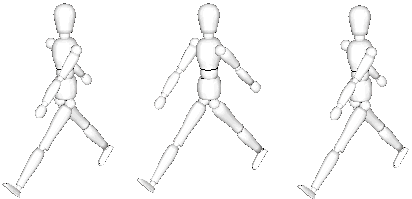 This plug-in provides the means to use Matt Scarpino's Skel animation module with existing model figures. There are dialogs that open from the context (pose and new frame) and View (Run, Auto name and Auto joints) menus. Please note the Ruby_tree.rb that helps process raw SU data and selections for the Skel bones seems to throw a loading error on any version other than Sketchup v 8.
Included are two example skps, one with four keyframes and one without. Please try them out. If everything is OK then I will explain how to make a model that can be auto-named and -jointed. (Actually I need a bit more time to finish the joint business).
There seems to be plenty of potential in expanding on Matt's original initiative including stringing together keyframe modules - ease in starts, repeating intermediates, ease out finishes and so on.
Edit Jan 28 2011
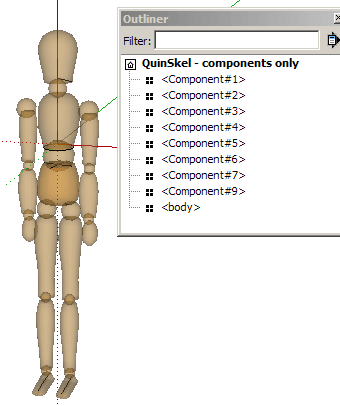
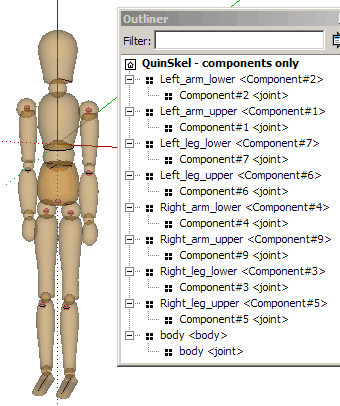
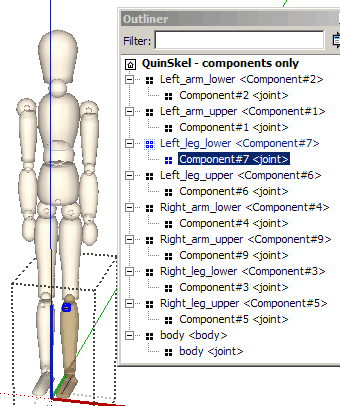
I have added the revised skel_ui.rb with the auto_joints and the skp that has the upper and lower limbs and body as components (to show what is needed from any model). There is no need to name the component definitions except for the body (must be called 'body'). Use auto name and auto joints and then check with view > faces > x ray & > shaded (to see red joints inside). Joint positions will probably need some tweaking. They are nested with their limbs, so need to open/close each to adjust and test as necessary.
edit: swapped zip - found error in pivot joints
edit: added pix of name, joints and adjustment
edit 1.02 observer added to clear variables pre save
extract to SU 8 plugins folder
QuinSkel - components only.zip
-
RE: Variable problem
@tig said:
I'm not clear about how a good or bad entry for 'value >>> v' might actually 'look' in your code...
<span class="syntaxdefault">new_value </span><span class="syntaxkeyword">=</span><span class="syntaxdefault"> </span><span class="syntaxkeyword">[]<br /></span><span class="syntaxdefault"> value</span><span class="syntaxkeyword">.</span><span class="syntaxdefault">each do</span><span class="syntaxkeyword">|</span><span class="syntaxdefault"> v </span><span class="syntaxkeyword">|<br /></span><span class="syntaxdefault"> if </span><span class="syntaxkeyword">!</span><span class="syntaxdefault">v</span><span class="syntaxkeyword">.</span><span class="syntaxdefault">is_a</span><span class="syntaxkeyword">?(Array)<br /></span><span class="syntaxdefault"> v </span><span class="syntaxkeyword">=</span><span class="syntaxdefault"> </span><span class="syntaxkeyword">[[</span><span class="syntaxdefault">1</span><span class="syntaxkeyword">,</span><span class="syntaxdefault">0</span><span class="syntaxkeyword">,</span><span class="syntaxdefault">0</span><span class="syntaxkeyword">],</span><span class="syntaxdefault">0</span><span class="syntaxkeyword">]<br /></span><span class="syntaxdefault"> end<br /> v </span><span class="syntaxkeyword"><<</span><span class="syntaxdefault"> time </span><span class="syntaxkeyword">*</span><span class="syntaxdefault"> a<br /> a </span><span class="syntaxkeyword">+=</span><span class="syntaxdefault"> 1<br /> new_value </span><span class="syntaxkeyword"><<</span><span class="syntaxdefault"> v<br /> end<br /> keyframes</span><span class="syntaxkeyword">[</span><span class="syntaxdefault">key</span><span class="syntaxkeyword">]</span><span class="syntaxdefault"> </span><span class="syntaxkeyword">=</span><span class="syntaxdefault"> new_value</span>I did it like this in the end as both types of
vhave time added. Anyway it works which is good! Thanks again.The empty elements currently are needed to delay certain rotations - like a kick at the end of a run. I have a mechanism to modularise the animation. I want to leave that until later.
-
RE: Variable problem
@tig said:
In which case
  ...
>   new_value = []
>   value.each do | v |
>     if v ### ??? ### isn't this what you want ?***
>       v << time * a
>     else ### OR it's nil
>       v = [[1,0,0],0]
>     end ### ***if NOT then revert to your format...
>     new_value << v
>     a += 1
>   end
>     keyframes[key] = new_value
>   end
>
Yes that looks good;I guess I can use
v.is_a?(Array)for the if bit as the nil candidates are just empty elements.Thanks to you both ...
-
RE: Variable problem
@tig said:
value.each do | v |
> if v.nil?
>   v = [[1,0,0],0]
> end
> v << time * a
> a += 1
> end
> keyframes[key] = value
> end
looks through the contents of 'value' and assigns some values to elements in array 'v', then it sets the keyframes[key] back to be value ???
Don't you want to modify 'key'?
Why don't you usekeyframes[key] = v???Value is an array of arrays (like [[1,0,0],0]). So v is one of those. I am sure it is caused by the nil block? (immutable??). Perhaps I should make a new array from the
v's because they are OK.I will try that later or tomorrow.
Thanks for your help.
-
RE: Variable problem
.... but
mapdoes work if there aren't any nil elements in thevaluearrays. -
RE: Variable problem
@thomthom said:
It doesn't work as you expect because you are not changing the content of the array. ....
Thanks but I am sorry to say it doesn't work at all.
Also my original code successfully adds the time to each (
v) array, it only seems the nil block is being ignored byvalue.So I don't know ...
-
Variable problem
Please would someone be kind enough to show me how to sort out this snippet?
def kf(time)
keyframes = {}
model = Sketchup.active_model
d = model.attribute_dictionaries['kframes']
d.each_pair do | key,value |
a =  1
value.each do | v |
if v.nil?
v = [[1,0,0],0]
end
v << time * a
a += 1
end
keyframes[key] = value
end
return keyframes
end
When I
putsthe v's all are correct, butvaluereturns the previously nil v' s to nil. Just cannot see why!Thanks
-
RE: Modelling models - Chinese New Year animation
All ruby plug-in in progress

-
RE: [Plugin] bim-tools 0.13.4(june 22, 2015)
@brewsky said:
@chrisglasier said:
"Buy this; put it here"
I do think that "a picture is worth a thousand words". "Buy this; put it here" would create an immense list for even the simplest building. ...
The reverse is also true as you suggest with your immense lists - it takes a thousand words to make a picture. And this is the real point immense lists are needed (I know I have been responsible for many.) They won't go away but the question is who makes them and how.
From the very start a designer starts to build lists, mentally or physically, names of spaces, elements, services and so on. If these can be captured many people can help to expand the lists of names and attach key/value pairs to describe each of them - kind of collective thinking out loud.
As the names represent physical objects they can be arranged in hierarchical relationships and if there are components with the same names can display alternative models backed up with data. This cannot be achieved with paperwork type processes, it needs machines that can communicate over the Internet. Rather than create walls from edges I want (and have done) to make machines from names.
-
RE: Has anyone successfully added dynamic 3D model to website?
Did you try downloading it? I tried with version 7 - don't work - but I see you have 6, so it might for you. Youtube is "unavailable" in these parts nowadays, but I seem to remember it made a set of six ortho images. You could do the same by making a plugin featuring
[write_image](http://code.google.com/apis/sketchup/docs/ourdoc/view.html#write_image)and standard views. -
RE: [Plugin] bim-tools 0.13.4(june 22, 2015)
@brewsky said:
But the reason I made it is to have the ability to easily create some meaningful objects that can be used as testcase for an IFC exporter.
In other words your main focus is essentially on paperwork type processes. But if you thought about object oriented information technology you could develop ideas how to identify and assemble objects and still produce traditional project documentation. A bit like creating a website that has potential to do many things but just using it to display a paper-like catalogue.
@brewsky said:
I don’t think designers want a tool that generates floorplans/buildings from a set of rules/demands.
You know it just might be site owners demand use of OOIT for its transparency and accountability, and designers have to comply.
@brewsky said:
Although it would be really cool to compare your design with “the perfect” computer generated floorplan
I think the reverse would happen; it would take a great deal of setting and resetting the criteria to reduce the options to say ten. Actually this is a way of delaying subjective judgement, providing a very high degree of accountability. Of course many designers rely on intuition, which is fine if the logical testing, which naturally follows any such lateral thinking proves it correct (which is one reason why building contracts are such a hassle).
@brewsky said:
they DO like the ease of drawing in sketchup! If you could just make the creation of meaningful objects really easy
even the building industry should not object
I suggest ... would respect, because you know buildings are not really built from drawings and specs. They are built from interpretations of them, as thumbnail sketches, setting out lines, purchase orders and so on. How much better a series of instructions: "Buy this; put it here" rather than "Need this, put it on the drawing (making sure the information is scattered over plans, sections, schedules and specification)"
@brewsky said:
Your opinions please
I am sorry I have run out of steam and time for the time being but you could have a look at my website for some examples what can be achieved. I know it is difficult to see beyond improving what already exists - e.g. evolving models from orthogonal drawings - most often the basis for competitive tendering. Toffler wrote: "Static competition may have produced the thoroughbred racehorse but it could never have produced the automobile." Competition in the building industry is static, something more dynamic is needed ... don't you think?
-
RE: [Plugin] bim-tools 0.13.4(june 22, 2015)
@dan rathbun said:
@brewsky said:
@dan rathbun said:
Somehow you need to add "building properties" to the "empty" SketchUp geometry.
See the API on AttributeDictionaries collection and AttributeDictionary class objects.
They can be attached to almost anything, including Layers, Scenes, etc. as well as base geometry, and Groups and Components.
There was a very long discussion in the General Sketchup Forum, (no activity since Sep.) here's the link:
Could SketchUp be transformed to a BIM or PEN System?
(It might be a good idea to post a notice in there, as those people interested, may come on over to this topic and discuss the Development.)@brewsky said:
Anyone interested in some more BIM discussion?

Please check out my topic:
http://forums.sketchucation.com/viewtopic.php?f=180&t=34007- jan
As I see it the intent of your plugin is to automate part of the creation of a model. This is fine but to me it is like banks providing a way to digitally write cash cheques rather than providing ATMs. The building industry hates real change and the IT industry is very happy to supply it with technology that comes with no information - i.e it requires typed input (see Dan's comment above). This is also true of word processing, spreadsheets and other digitised paperwork apps.
Your edges ... where do they come from? They are the result of design, no? Do you think it would be better to define the relationship between spaces - access, privacy, fire, sound and other such criteria - and then generate the dividers from that?
In other words would it be better to select criteria from existing know-how and get technology to search for and display possible solutions - a mashup of Sketchup, Napster and Twitter with a twist of straightforward commercial trading perhaps?
-
RE: RAILWAY DRAWING
@dolphus said:
Axeonalias I dug back into my murky archive an found these:-

Do you know why it has the door and setback at the front?
-
RE: Definition.instances upset
Takk!
Now you have said it I feel somewhat foolish ... oh well ... time to go to the pub. Maybe next year I can do better.
Happy New Year to you and all the other members.
Chris
-
Definition.instances upset
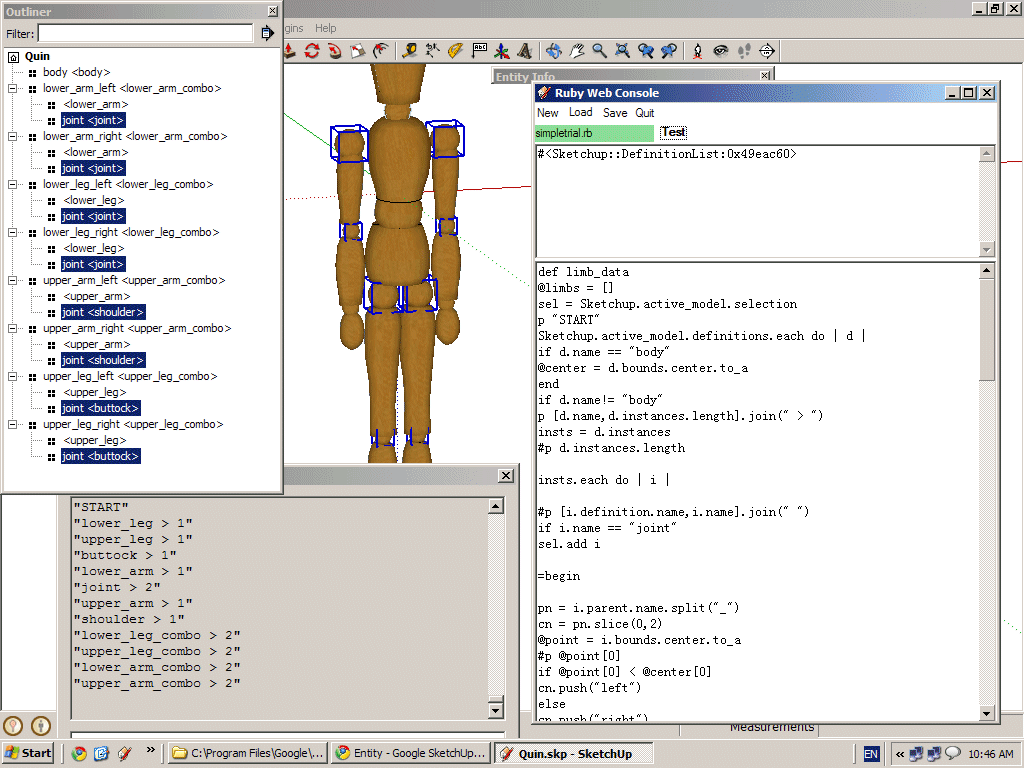
I hope someone can see what is wrong here. I can add all the definition instances to the selection but I can only return half of them as shown in the console. Sorry it's rather messy, made worst by the impossibility to indent.
Thanks and Happy New Year.
-
RE: Modelling models - Chinese New Year animation
@chrisglasier said:
I forgot about Matthew Scarpino's Skel Module - see page 278 in "Automatic Sketchup" - so I am having a go with that.
Well I have made a little progress and Matt has said he will help to get to where I want. In the meantime I thought some members might like to have a play, perhaps make a dialog to specify the keyframes ... "see if you can get it to cross its legs" kind of thing or more ambitiously with movable fingers and hands demonstrate how to bowl a googly. Note: each 'bone' has two parts one of which is named 'joint'. It can be any size, visible or not, as the origin of rotation is its bounds.center. The animated series of rather jerky screenshots indicates what it does right now.

I used Jim's webconsole to test it and have included it in the zip file. Extract into plugins folder open Quin.skp and webconsole and then load mann2.rb. After each test you need to File > Revert. Do not save the file as currently the parts lose their names.
The mannequin is from the warehouse, made by Arqdirk, with some realignment and componentisation. My code is an adaptation of Matt's tutorial - see quote - corrected by Jim but still in need of rationalisation and optimisation.