Sketchup is Inacurrate???
-
Why does this matter? Is the project going to be build with a CNC machine or by a carpenter? The carpenter will read and cut to the correct dimension. A CNC machine the will facet the curve incorrectly. How many buildings are built with CNC machines. This is an honest quest as I don't know if it really matters. For a machine designer it would be critical if CNC is used in manufacturing. If the plans are meant to be read by a human and are annotated properly I don't see the problem.
-
@roger said:
Why does this matter? Is the project going to be build with a CNC machine or by a carpenter? The carpenter will read and cut to the correct dimension. A CNC machine the will facet the curve incorrectly. How many buildings are built with CNC machines. This is an honest quest as I don't know if it really matters. For a machine designer it would be critical if CNC is used in manufacturing. If the plans are meant to be read by a human and are annotated properly I don't see the problem.
lol.. you're right.. the carpenter will read and cut the dimension given.. only it's the wrong freaking dimension

-
@andybot said:
oh. learn something new every day... I guess this one is a dead horse of the highest order. Oh well, back to ACAD.
Edit: oh hell, I'm back for more. The profile width is absolutely correct with follow me, but why is it not correct in your example? (5.489")
it's because you're measuring the arc wall at the wrong point.. i want to build a curved wall -- not one consisting of a bunch of straight 2x6s mitered together (in which case yes, the 5.5" width would be proper)..
but it's an arc -- and theonly place an arc is accurate in sketchup is the vertices.. you have to measure your arcs/circles etc from there..
edit.. for instance.. draw a circle in sketchup then draw a few diameter lines across it… the only place where the lines will be the true length are at the vertices.. if you draw a line connecting a segment to a segment, it's going to be shorter than the actual diameter
-
Are you beating your head against a wall there?
-
It's for that is not very cautious to build an atomic Plant from Su but no problem for draw it!
-
@unknownuser said:
@roger said:
Why does this matter? Is the project going to be build with a CNC machine or by a carpenter? The carpenter will read and cut to the correct dimension. A CNC machine the will facet the curve incorrectly. How many buildings are built with CNC machines. This is an honest quest as I don't know if it really matters. For a machine designer it would be critical if CNC is used in manufacturing. If the plans are meant to be read by a human and are annotated properly I don't see the problem.
lol.. you're right.. the carpenter will read and cut the dimension given.. only it's the wrong freaking dimension
I would say the problem is with the architect who inserted his dimensioning at the wrong point on the drawing. In this case wouldn't you insert your dimension at the vertice where the measurement is correct? Or manually change the dimensioning if it MUST be inserted at another point? Not arguing, just filling gaps in my knowledge.
-
@roger said:
I would say the problem is with the architect who inserted his dimensioning at the wrong point on the drawing. In this case wouldn't you insert your dimension at the vertice where the measurement is correct? Or manually change the dimensioning if it MUST be inserted at another point? Not arguing, just filling gaps in my knowledge.
the real solution is to draw it accurately in the first place. that way, the drawing is accurate and the dimensions are accurate... and any subsequent geometry in the model will be accurate and so will those dimensions.. and so on and so forth.
drawing sloppy then editing dimension is both hack and inefficient..and again, you can draw this wall accurately in sketchup and obtain proper dimensions etc. it's just that you can't use certain tools (which should be the right ones for certain situations) to obtain the true dimensions.
-
@unknownuser said:
Are you beating your head against a wall there?
not quite. getting there though. hopefully I'll just give up before any cranium crushing over this

-
Now that I dig under the surface this become more interesting. I just drew two circles within each other and used the dimensioning tool to obtain the diameters. They are both accurate at any point on the circle (vertex or not) as long as you don't explode the circle. Also if you dimension the circle at any point and then explode the circle, the dimensioning does not change. Now I wonder if you could create a special ruby that allows you to click between the inner and outer vertex for a correct board dimension and the apply that dimension anywhere on the circle when you make a third click on the circle. Said differently, the first two clicks determine the correct distance and the third click will attach that dimension to the circle at the point of your third click. I think we may have invented something usefully similar to the angle dimensioning ruby. Anybody want to write the tool?
-
@wo3dan said:
@wo3dan said:
..
Let me put it this way: you use 2x6 for the base plate. It's not a 2x6 anymore in your correct example.yes and no.. 2x6 for the straight sections.. 2 layers of 3/4" ply with the arcs drawn/cut from the larger piece for the round plates.
(ie. you can't cut a 5 1/2" wide arc in a 5 1/2" wide board).. the actual laminated plates on site are true radii.. not segmented as it appears in sketchup..
-
@roger said:
Now that I dig under the surface this become more interesting. I just drew two circles within each other and used the dimensioning tool to obtain the diameters. They are both accurate at any point on the circle (vertex or not) as long as you don't explode the circle.
right.. that's what i was getting at earlier in the thread.. notice also that if you look at the entity info's expanded view of a 'circle' or 'arc' , it will accurately list its length.. if you explode it, it will then show the sum of the segments' lengths..
so what i was saying is that since sketchup is 'smart' enough to recognize when a user wants an arc/circle and provide accurate properties of said curve (as opposed to a collection of straight lines), then i wish it was also smart enough to transform the geometry according to the way the user has assigned it..
if it's an arc, move the vertices.. if it's a collection of edges, move the segments.. it's really that simple
as it is now, it treats all geometry, regardless of the type, as a collection of straight segments when offsetting/sweeping.
your ruby idea, while i see what you're saying, would pretty much be a waste in most situations unless sketchup would also move the geometry accurately.. if the ruby was made then you tried to use it on geometry obtained via the offset tool, it would just show you that the drawing is messed up..
edit- well, that, and i'm pretty sure these ruby geniuses don't have much (if any?) access to dimensioning tools..
-
Well someone created a much needed angle dimensioning tool that worked as I describe.
-
@roger said:
Well someone created a much needed angle dimensioning tool that worked as I describe.
yes though i think it works differently then the way you new idea would have to..
(but, i'm way out of my league on this one.. i don't actually know what is/isn't possible with ruby.. and these guys continue to surprise me over and over again)
-
Hey Jeff,
So then for something more precise, wouldn't you increase the segments on the curve so that you are approaching (mathematically) a true curve? The example you had only a small number of segments (I'm assuming to highlight the error in offset versus starting point.) With, say, 30 or 60 or something segments, whatever you need in proportion to the scale you're working, you can reduce your inaccuracy per section to the thousandths of an inch. -
@unknownuser said:
@wo3dan said:
Let me put it this way: you use 2x6 for the base plate. It's not a 2x6 anymore in your correct example.
yes and no.. 2x6 for the straight sections.. 2 layers of 3/4" ply with the arcs drawn/cut from the larger piece for the round plates.
(ie. you can't cut a 5 1/2" wide arc in a 5 1/2" wide board).. the actual laminated plates on site are true radii.. not segmented as it appears in sketchup..
like so:
![big sheet of plywood.. it's 16 sheets of 3/4" 4x8ply glued/arranged into a single piece of 1.5"thick 16' x 16'.. (for pilou, that's nearing 40mm 5m x 5m) [click pic -> bigger]](/uploads/imported_attachments/477q_bigply.jpg "big sheet of plywood.. it's 16 sheets of 3/4" 4x8ply glued/arranged into a single piece of 1.5"thick 16' x 16'.. (for pilou, that's nearing 40mm 5m x 5m) [click pic -> bigger]")
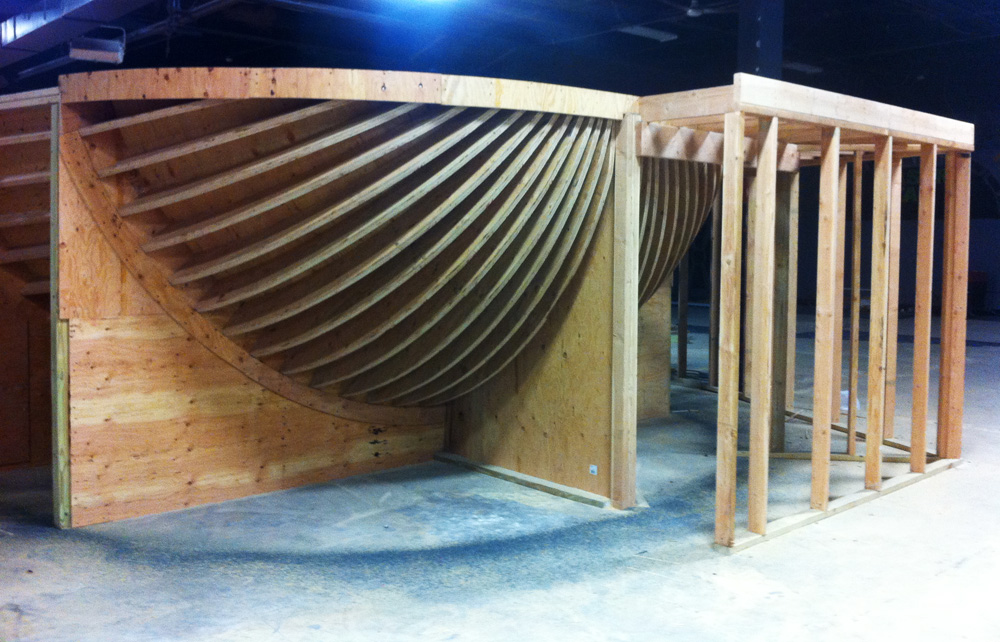
i guess half the point of me posting those pics is a way of me saying that my earlier arced wall example is super basic to me.. i've been messing with this stuff for most of my life.. at first it's figuring out an arc.. then trying out spheres 92', then (i'm not even sure what the shape is called.. looks sort of like a frying pan).. next comes egg shapes.. the picture above has an elliptical top then a 7-9rad as one side and a 6-3rad as the other.. which have to maintain continuity between it's mirror as well as an egged bottom..
then.. a little bonus is that i can roll around on those things and if something is off, i'll know it.. it will tell me if my numbers were wrong.. and rule 1 on the path to being a master carpenter is: no kinked ramps! : ) ..i'm quite confident about a vertical wall with an arc in there.
the other half as to why I'm persisting in this is awareness.. i guess a reason as to why people aren't requesting this to be examined by SketchUp
 is that not too many people seem to see it..(fwiw, until recently, i always assumed this ill behavior was known and just accepted.. or hey, maybe nobody really cares about it anyway, but,) to me, it appears as though this is something that can be fixed in the software.. it might be closer to sketchup's core as it spreads across multiple tools but i do think it's fixable.. i pretty much understand everything jbacus has said/explained over the years as to why something can't happen with the app or why it makes no sense to include something but with this, i'm pretty sure i'd disagree with him if he said it weren't possible or worth it.. That said, i know the programmers at least understand what i'm saying here.. you don't write/maintain this level of software without seeing this
oh, hey..can we get a sketchup rep in the thread ?
-
@andybot said:
Hey Jeff,
So then for something more precise, wouldn't you increase the segments on the curve so that you are approaching (mathematically) a true curve? The example you had only a small number of segments (I'm assuming to highlight the error in offset versus starting point.) With, say, 30 or 60 or something segments, whatever you need in proportion to the scale you're working, you can reduce your inaccuracy per section to the thousandths of an inch.no, increasing the amount of segments is not the proper solution.. it causes problems in more ways than one
in the wall example, the arc only has a vertex when necessary which is on the midpoint of a stud where it meets the plate (the vertices are in the same place the layout marks will be once building full scale).. the rest of the arc's lines don't even need to be on display.. they are useless other than their visual assistance.. no need to fill that space in with more lines and vertices.. it makes snapping to key locations much more fidgety as well as dampens performance / increase file size..
but don't get me wrong.. the above method is the precision/performance technique.. if i'm going to be rendering, i will increase the amount of segments 2 or maybe even 3 times..
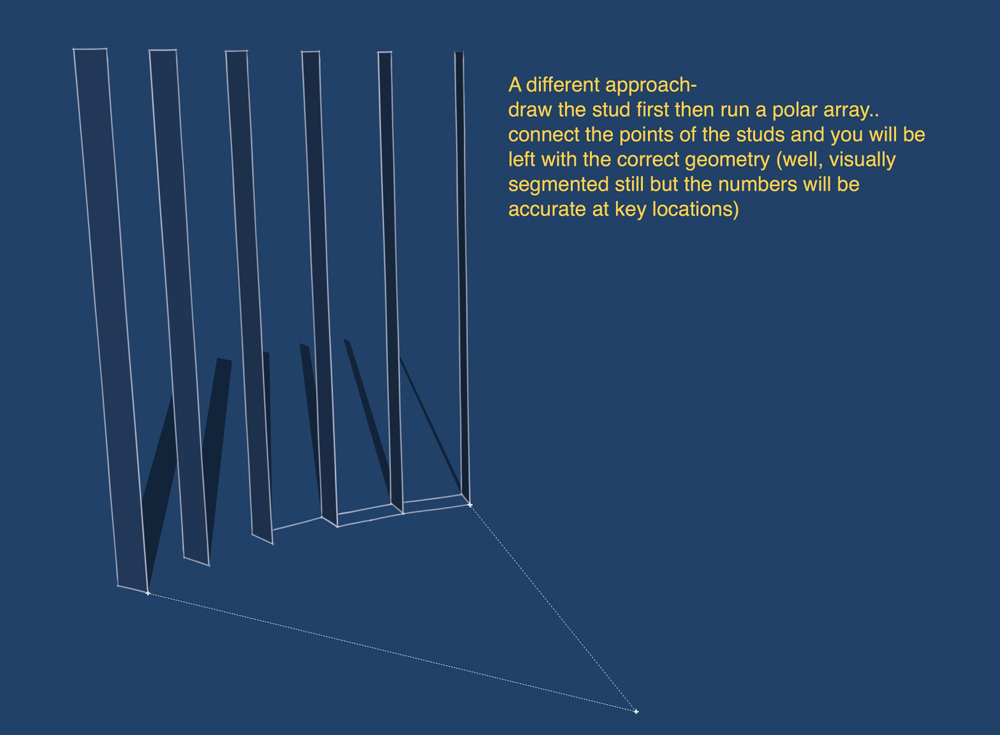
[EDIT] hmm.. talking about vertex position made me think about using this as an example of why you should take the measurements at the vertices.. let's forget about drawing the arcs first and concentrate on how we know the verticals should be.. the studs are rotating around a circle.. you know they are 5.5" wide therefore the plates should also be 5.5" wide -- when measured along the orientation of the vertical boards..
-
@unknownuser said:
@unknownuser said:
@wo3dan said:
Let me put it this way: you use 2x6 for the base plate. It's not a 2x6 anymore in your correct example.
yes and no.. 2x6 for the straight sections.. 2 layers of 3/4" ply with the arcs drawn/cut from the larger piece for the round plates.
(ie. you can't cut a 5 1/2" wide arc in a 5 1/2" wide board).. the actual laminated plates on site are true radii.. not segmented as it appears in sketchup..
i guess half the point of me posting those pics is a way of me saying that my earlier arced wall example is super basic to me.. .......
I took your example as working with 2x6 as can be seen in the scenes.
But as part of a (not so) smooth shell for scating, no, that's a whole different ballgame causing headaches. And the pictures show that you carefully cut out the curved plates, nothing straight!
I think changing SU's offset tool would make many others unhappy, introducing all sorts of other difficulties and inaccuracies.
But in your case (since SU has no circles and arcs, only segmented ones) just use it for straight lines.
If you predefine the studs spacing => the number of segments, all you need to do is fill in the tangent inner arc(s) later between straight offsets. I think it will perfectly meet your requierements to create accurate plates for framing for smooth shells. See:
-
Any chance to have this last file in V6? (Save as)
-
@unknownuser said:
Any chance to have this last file in V6? (Save as)
Here is a version 6. In the V8 one I forgot to alter the text in 3 segments in the second example.
p.s. this correct construction according to Jeff's requirements can be done in no time. It's only a decission of which tool to use when.
-
Thx for the V6
With your measures
Seems a good approximation (verification outside SU)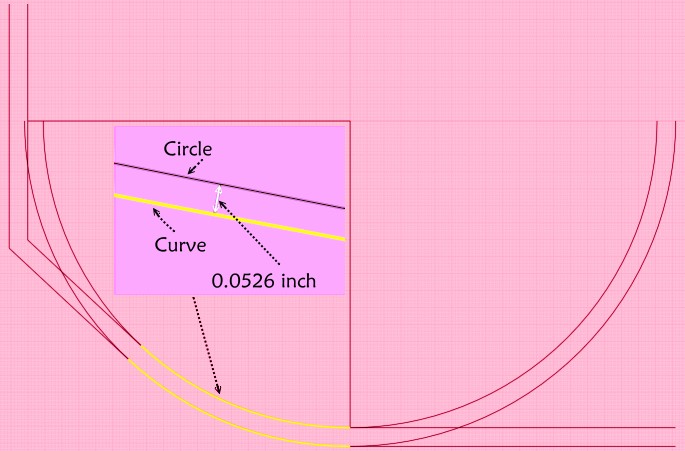







Advertisement