Thanks Andrew. There is a new thread at
http://www.sketchucation.com/forums/scf/viewtopic.php?f=80&t=12770 which has an introductory video.
Chris
 C
Offline
C
Offline
Thanks Andrew. There is a new thread at
http://www.sketchucation.com/forums/scf/viewtopic.php?f=80&t=12770 which has an introductory video.
Chris
@unknownuser said:
Putting a 2d front end on a 3d world...seems too difficult (and a bit backward).
Yes you have put your finger on one of the main problems I set out to solve. It seems I failed to point out clearly that each column can be in a different plane. A list of floors, in section; a list of spaces, on plan. This is the same problem that Lotus tried to solve with Lotus 123 v4 in 1987 - the first multi-sheet spreadsheet; so you are right, it is a bit backward, but in my view it wasn't really solved then and needs revisiting. It's interesting, and a bit surprising, that tech savvy Architects like SOM and Onuma Inc. rely on Excel for data exchange. It is surprising because the data becomes non-clickable. At the very least you could say that namesets is an alternative for that.
There is a website you can visit by clicking the button on the left.
Many thanks for your feedback - always useful.
My regards
Chris
PS You can also think of a nameset as an index of associations where 2D and 3D are irrelevant. V Bush first talked about associative indexing in 1945 - now, that's going back!
[flash=425,355:1le90ag3]http://www.youtube.com/v/Ejkxu67jtE4[/flash:1le90ag3]
Here is the first version.
Chris
Full video of Kevin Kelly's talk at http://www.ted.com/index.php/talks/kevin_kelly_on_the_next_5_000_days_of_the_web.html
web restructuring at 11.10 - 13.14
@cphillips said:
Chris, I like that UI. The animation is a nice touch. You don't use any libraries for creating the HTML from JavaScript?
Thanks, I introduced the animation because the redisplay was so damn quick, it was confusing, particularly going backwards (left). Now I think it is good because it shows the interface is a machine in its own right, not a metaphor for paperwork. From the other post, you will see I'm a builder; I find my tools not at the library but at the builders' merchants!
Chris
Actually I am a builder responsible at various times for shopdrawings, time scheduling design, procurement and installation, purchasing, logistics planning, progress payments, and so on on large projects like Hong Kong Bank (on the back of HK$ notes), Chek Lap Kok airport, Alexandria Library in Egypt, Sheraton Hotel Baghdad. So at least I understand the problems with processing data with and without different types of software. Mainly I fell back on spreadsheets, but was always aware right from 1984 (SuperCalc v1.0) of their limitations. This is the problem I am trying to solve. No graphic designer nor programmer, I had to tackle these tasks because no one else could see the point.
@morisdov said:
It would be nice if you can clearly and simply explain what is the problem your solution solves.
Well I will try but maybe you don't see the problem as a problem!
What you are doing is helping Sketchup modelers, what I am trying to do is to help John and Jane use Sketchup models to ease their daily toil (an idea relevant to this forum and good for modellers I think).
At http://www.ted.com/index.php/talks/kevin_kelly_on_the_next_5_000_days_of_the_web.html Kevin Kelly explains that the Web used to be about linking computers, now it is linking pages but it is gradually restructuring to link data. Data belongs to physical things. And physical things can be represented by models.
Not everyone needs models to do their work, but generally models are helpful, essential in a design where nothing else but a site and ideas exist. Ideas for things like baths can be represented by nouns, their generic names but they only become recognisably unique and useful when they have an address and some functionality; that is what a nameset gives them.
If you believe data linking is the future (consider where Google is going before dismissing) then data must be accessible to all. In this case, it is crazy to enter a value in the VCP, if the only way to extract it is by using an exporter and passing it to "die" (unclickable) in an Excel cell. What would be good is a Sketchup method to trap such data and store it directly in plain text so that it can be automated to link up with other data on the Web, for example, a building design stored essentially as links to building products + their xyz's.
@morisdov said:
Components are organised in standard component libraries - your solution adds an [color=#008080][b]additional hierarchy tree to organise components ?
A nameset does not add anything to Sketchup except the dialog with a few callbacks. It provides its own separate hierarchies by assembling names associated with specific tasks (one of Gaieus' digs perhaps). The association can be physical, temporal and so on, or a combination as a nameset can have devices to link and cross link. If the association is physical, the names can be used to pick up models and position them, if temporal the models can be animated.
@morisdov said:
Other 3D CAD tools have extensive RDBMS systems linked to them, decades old legacy and enrichment. Sketchup came very late to this party and it will not compete with the old monsters.
Gee come on. This sounds like the senator who raved that man would not enter space until the next century (the year before Gagarin did), or the "toy" personal computer and monster mainframe, or hundreds of others similar. I never imagined you as a stick-in-the-mud.
Please don't take offense, I am happy to discuss such things with you
Chris
You asked: So what are you doing?
Please let me know whether what you see on the nameset web site http://sites.google.com/site/namesets/is of interest. If so, I would be happy to discuss why, for example, I generate just about all the HTML with Javascript.
A standalone nameset in Chrome is much faster, so I agree it should be made the default or at least an option. After all they are from the same company.
Chris
Anyone know whether it will be enabled for the web dialog.
Yes it is so good I want to ask whether I could use the skp file in the Nameset videos we are making? Some explanation is given here:
http://www.sketchucation.com/forums/scf/viewforum.php?f=261
Many thanks for your consideration.
Chris
@gieselmant said:
I had this same problem. ... Hope this helps.
Thanks, I have as they say moved on, but I may well go back to it in the future when your advice will be undoubtedly useful.
Cheers
Chris
facer sent me a PM, some of which he said I could post here:
@unknownuser said:
Chris,
Industry Foundation Classes (IFC's) are the building blocks for products in CAD programmes.
Do your "Namesets" have any link or connection with IFC's that are
used by these CAD programmes?
Leading lights in the Architectural World like Paul Seletsky of SOM and Kimon Onuma of Onuma Inc often refer to diagrams - see http://www.aecbytes.com/viewpoint/2008/issue_37.html and https://www.onuma.com/products/ - that show data passed back and forth between Excel spreadsheets and IFCs. Namesets is a modern automated alternative to spreadsheets and so in this sense it has similar links.
But a nameset is a model rather than a digital version of a ledger and therefore fits more naturally. Each name represents something physical (as with IFCs), and exists to receive or report data from various people who have an interest in it - owner, designer, authority, manufacturer, builder, user, cleaner and on and on. There is no requirement to think about files, sheets, columns and rows, formulae, CSVs, cut and paste ...
We would welcome your support in the further development of namesets.
Chris
facer sent me a PM, some of which he said I could post here:
@unknownuser said:
Chris,
Industry Foundation Classes (IFC's) are the building blocks for products in CAD programmes.
Do your "Namesets" have any link or connection with IFC's that are
used by these CAD programmes?
Leading lights in the Architectural World like Paul Seletsky of SOM and Kimon Onuma of Onuma Inc often refer to diagrams - see http://www.aecbytes.com/viewpoint/2008/issue_37.html and https://www.onuma.com/products/ - that show data passed back and forth between Excel spreadsheets and IFCs. Namesets is a modern automated alternative to spreadsheets and so in this sense it has similar links.
But a nameset is a model rather than a digital version of a ledger and therefore fits more naturally. Each name represents something physical (as with IFCs), and exists to receive or report data from various people who have an interest in it - owner, designer, authority, manufacturer, builder, user, cleaner and on and on. There is no requirement to think about files, sheets, columns and rows, formulae, CSVs, cut and paste ...
We would welcome your support in the further development of namesets.
Chris
@manofskill said:
But I'm not sure how you would simulate a double click in ruby.
There's the rub!
Chris
@manofskill said:
Thanks for inviting me to this thread. I think I understand what you are trying to accomplish with Namesets and why it would be so powerful ...
Your reaction, very welcome of course, took me by surprise, so please give me some time to think about what's what, ... and for others to register an interest?
Kind regards
Chris
Thanks Jim.
One aspect of designing Namesets as a kind of remote control is highlighting the components or groupings in the display. So, in your example, you can highlight the group, but as far as I can see to highlight parts of the group you need to explode it. If that is true, maybe I would be better off keeping with just top level components highlighting them individually in the way you showed me before.
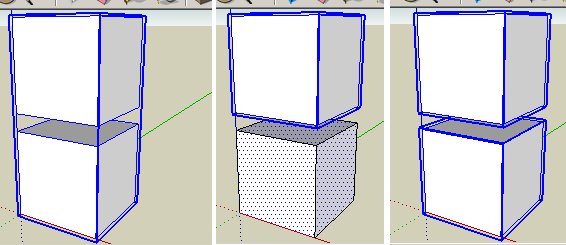
Maybe I am just thinking aloud - but if you have any pearls of wisdom I would be pleased to have them.
My regards
Chris
Thanks Jim, highlighting selections works just fine ... so this leads me to believe that with help and time I just might manage the rest. This video called "Hidden components" http://www.youtube.com/watch?v=fso03-LFXTQ shows what I want to achieve, but by using the nameset interface to explore and/or manipulate the display.
At the risk of repeating myself too often, I am not trying to outsmart the Sketchup people nor anyone come to that; I just want to automate all tasks that relate to names of things that exist or are planned to exist in the world with a common set of records and non-propietary software (HTML).
It seems to me that nested components are at the heart of my current adventure. Is that so? And, if so, do you have any pointers to help unravel what appears to me a complex tangle of funny words.
Thanks
Chris
PS Yes Jim, at the moment they are all top level instances. Only the names are structured in a hierarchy.
@jim said:
Ok, that's easy.
That's great. I will try to get to grips with the detail tomorrow (quite late here now).
But I'm thinking that probably I will need to make collections of components into a group and then groups into other groups as I move up the hierarchy. It is as if a project is a string bag; as I select objects with set dimensions (building products), I place them in a small string bag and put that bag into another bag. The project bag expands as more bags of bags are added and it starts to take up some shape. Sounds a bit weird but I think that's how it kind of works. (Substitute bounding boxes for string bags.)
Anyway I will sleep on it and try to post something vaguely sane tomorrow.
Tp
Chris
@jim said:
I'm not sure I understand what you are asking...
BoundingBoxes are not meant to be displayed in SketchUp - they only provide the dimensions of a theoretical box around its contents.
Yes I think I understand that. Its something like a "<div><div>A block in a div holder</div></div>". At the simplest level I want to simulate a "click" on a component by clicking on a name in the web dialog so that the box turns blue.
If this is possible then there is more to discuss.
Many thanks ... toodle pip!
Chris