Could SketchUp be transformed to a BIM or PEN System?
-
.
Interesting post over at Google Groups: -
I'd like to point out that while all of your comments are PART of what BIM is, it is not complete.
BIM is taking parts and putting them together to make a finished product. BIM is able to categorize how many lineal feet of blueboard you need. BIM is making a change in the process (like changing a window), and it will autoreplicate through the entire project including the bill of materials or estimating form, thus giving you a revised cost of the project. For Civil folks, BIM is knowing how much dirt is needed to haul away or bring into the site. It is knowing how much 24" diameter smooth-lined plastic pipe (SLPP) is needed, how many type-c catch basins. It is knowing when there is an interference (two items trying to occupy the same space).
Having said that, SU can use components, but (unless I am unaware of any), be able to track quantities used for estimating. I think it is completely doable, but would take massive work to really be called a BIM system.
My thoughts only.
Rick
-
@mike lucey said:
Here is the link to DoubleCAD, http://www.doublecad.com/
and this video showing how it works with SketchUp, http://downloads.imsidesign.com/Flash/DoubleCADFlash/Import-From-Sketchup-800-600/Import-From-Sketchup-800-600.htm
Mike
Unfortunately, Mac users are out in the cold with this software as they only have PC.
Rick
-
In my mind it is pointless tinkering around. Building and allied industries and consultants need a complete change of approach, getting rid of paper oriented processes and rule of thumb allowances. Only then can a proper transition be planned to accommodate the reactionary majority.
Don't you think?
-
@chrisglasier said:
...Building and allied industries and consultants need a complete change of approach...
As I read through the entire thread I was thinking something similar. Rather than asking, "How can we use Sketchup like BIM to get 2D drawings out of our 3D models?," maybe we should be asking, "How can/should we use Sketchup to successfully document our design?"
In essence, CAD is digital drafting and BIM is 3D digital drafting. Neither of these tools really change the way we communicate our designs to contractors. Sketchup has changed the way many architects design and how they present that design to clients. I think the time has come for it to change the way we document our designs as well. As of today we are stuck with handing contractors our design in a 2d format (paper, PDF). However, what we put on that 2d page can make a huge difference.
Here is a real-world example to illustrate...
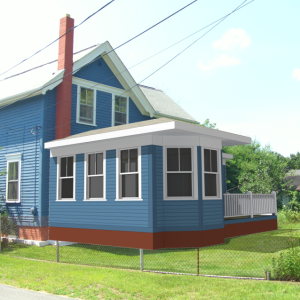
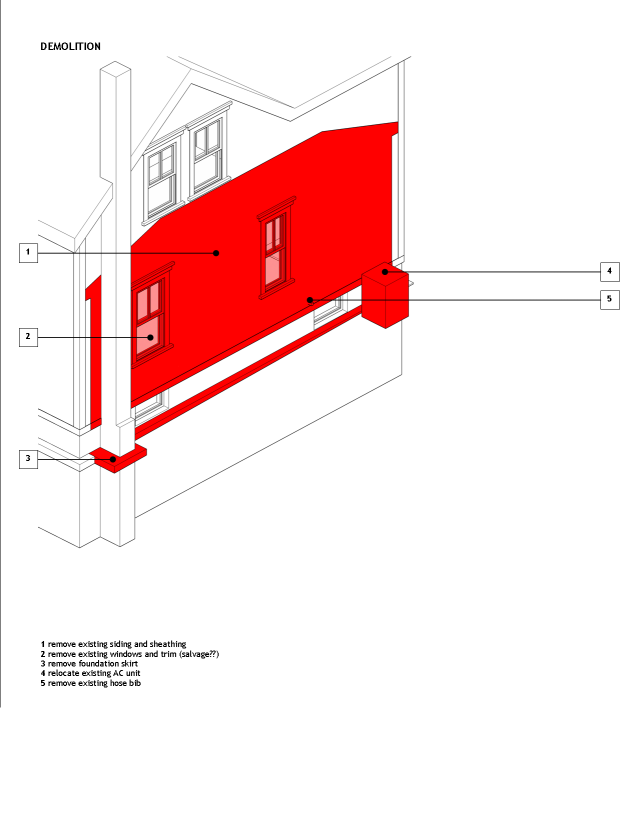
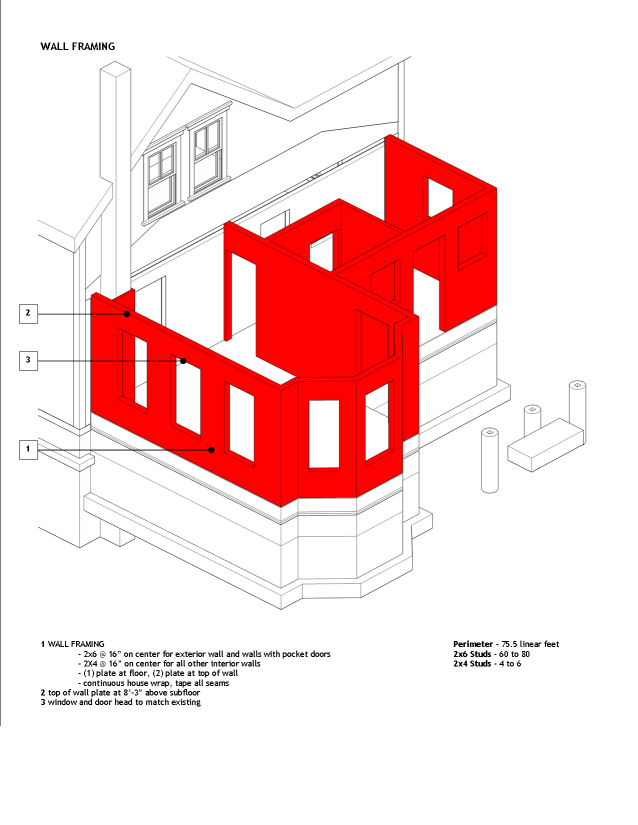
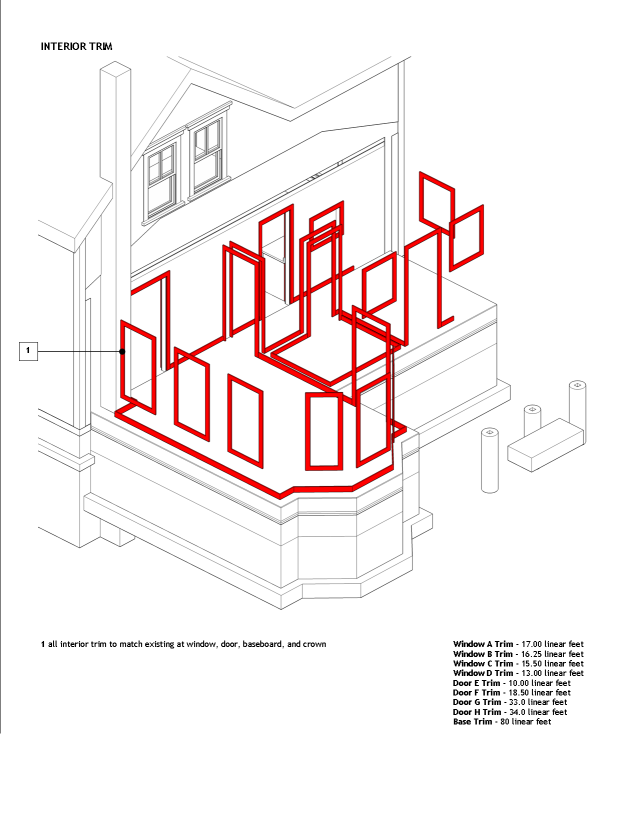
I was asked to design a small addition for a young couple near where I live. After the design was finalized, I created a detailed Sketchup model built the way it would actually be constructed in the field. From that Sketchup model I extracted categorized 3d views which relate directly to the sequence of construction (demolition, wall framing, interior trim, etc...). These 3d views include quantities and sizes which relate to that specific construction task for contractors to price. Furthermore, these tasks integrated directly with industry standard construction specifications. In the end, this work leverages the information in the 3d model into something which truly improves the way we deliver a design to a contractor. It makes the 3d model more useful and the designer a more integral part of construction. I can say from experience that this work was extremely well received by both the client and contractor. In the end pricing the project was much easier and the the finished product was exactly what the client expected.
So although the title for this thread is "Could SketchUp be transformed to a BIM or PEN System?" I think we should be asking ourselves if that is really the direction we want to go, or if Sketchup gives us the opportunity to do something even better.
-
@kgr said:
@chrisglasier said:
...Building and allied industries and consultants need a complete change of approach...
As I read through the entire thread I was thinking something similar. Rather than asking, "How can we use Sketchup like BIM to get 2D drawings out of our 3D models?," maybe we should be asking, "How can/should we use Sketchup to successfully document our design?"
What a welcome first post. I think we are of like mind. Please have a look at this 3.5 min video, and if I am right I would like to start a JV-type topic with the caption "Using Sketchup to communicate instructions."
We can agree on the exact wording but I want to get away from document and emphasise instructions. I say this because buildings get built by instructions, simply put, "buy this, put it there". These instructions are currently drawn from interpretation of orthogonal drawings. The form of instructions is not so important as first realising their significance.
I think the forum will benefit from a fresh look at this subject.
Thanks
Edit: These instructions are currently drawn from interpretation of orthogonal drawings.
-
As far as I have experienced, a program that is capable of doing everything compromises its parts. If the architectural process is design, production documentation, and construction, then each phase is best represented by a program designed accordingly. To make the whole work, at best each phase must output "something" that can be easily used by the other phase, ideally in both directions. I believe that SU is a ideal product between "bubble diagrams", and 3d models of a design. LO is a program that applies itself to presentation, and Su via file transfer, to 2d production documents.
-
@honoluludesktop said:
As far as I have experienced, a program that is capable of doing everything compromises its parts.
Please understand that I am not talking about a program but a scheme, something more akin to the characteristics of the web. People use specialist devices to participate in the process of creating or even using a building. Models - components, sub assemblies, buildings - attract and hold data and interpret it for various needs. There is no passing of output. The only physical output is the real thing.
I think, if I might say so, you see computer programs as solutions.
They are not, but they could become enablers once the method of the working was changed. This would define the real objective - for Architects I hope this is the creation of a building not a beautiful set of drawings - and open up use of the web with multimedia to communicate the instructions that get buildings designed and built.
-
The good thing about SU is the way we can sort of directly manipulate the model by pushing in and moving right until we are satisfied. Using BIM packages still resembles more filling tax forms than sketchupping. That's why I am still dreaming of a SU with a more direct link into BIM rather than increasing the BIM'ishness of SU.
Anssi
-
Anssi, I agree. Its like a "one-in-all" solution that takes 10 steps to dimension a edge, vs. a dimensioner that will do it in one step. If however, someone comes up with a "all-in-one" that is all in "one step", then OK, I will be among the first to stand in line to get one (that is, after the first service release:-).
Chris, what you propose is conceptually elegant, but beyond my ability to grasp "the mechanics of". Besides, I like beautiful "working drawings", and will be sad to see the day they are gone, just like my overnight color pencil sketches.
Sorry for all the "off posting".

-
@honoluludesktop said:
is conceptually elegant, but beyond my ability to grasp "the mechanics of". Besides, I like beautiful "working drawings", and will be sad to see the day they are gone, just like my overnight color pencil sketches.
hi all, for my two pence worth,
I also, I like my working drawings, and I want to bury all the boring details inside them.
I can do this by adding layer upon layer of digital information, but I need a digital management tool to navigate quickly from grouping to grouping.I see Chris's tool as a PushPull tool for digital information, which lets me stay in SU longer, giving me more time to do additional renderings, which being part of the single information package can be presented at every possible opportunity I choose. Each project contains all it's own ideas, content, ingredients, I find that fantastic.
I'm trying to help get this working on Macs to give me the single document functionality that is already available to the brave PC user's amongst us. No doubt it's got a way to go before it's a day in day out functional tool, but it can be if people help develop it.
john
keep up the good work chris..
-
@anssi said:
The good thing about SU is the way we can sort of directly manipulate the model by pushing in and moving right until we are satisfied. Using BIM packages still resembles more filling tax forms than sketchupping. That's why I am still dreaming of a SU with a more direct link into BIM rather than increasing the BIM'ishness of SU.
Anssi
Yes that is exactly why I was attracted by Sketchup. I just want to make it better by capturing information at the very moment it's needed to make a model. In this way you have both the model and its data available for scrutiny all the time. If you want to delay a decision about placement or procurement you can test the financial and temporal consequences prior to doing so - perhaps a basis to detach the building industry from its outmoded ties.
@honoluludesktop said:
Chris, what you propose is conceptually elegant, but beyond my ability to grasp "the mechanics of".
The mechanism is the concept. I am sorry I find your post surprisingly paradoxical and reactionary, so cannot really comment further.
@driven said:
I see Chris's tool as a PushPull tool for digital information.
Yes I think that it is a good way of putting it. The key, like bar coding, is to give components identities and link them to a digital record. Given today's amazing communications technology data can be pulled and pushed around to provide pertinent multimedia displays.
@unknownuser said:
Each project contains all it's own ideas, content, ingredients, I find that fantastic.
Not just the project but also each component.
Thanks for your support and particularly your efforts to make it Mac compatible.
-
@mike lucey said:
I am of the 'old school', I started with a pencil, drawing board, T-Square, Set Square and Scale Rule and later on an adjustable? ...... God I've forgotten what it was called ..... eeeeerrrrr .... hold on! I have it now, Adjustable Set Square! Boy were they handy, saved all that messing around with the protractor

I had no difficulties in producing plans, elevations, sections and isometrics also the occasional perspective view for jobs. When computing came into the picture it should have made things simpler BUT this was not the case IMHO. Things became somewhat more complicated for me until SketchUp came along. I initially worked on MicroCAD, this was a decent attempt at 3D. It ran into financial difficulties and was shelved. I was then stuck with AutoCAD ..... the adapted Word Processor Program for draughting!
Mike
Very good comment you are making. I think what made these "old School" production methods work so well is that you were intimately aware of what you were doing. With all this technology we have lost awareness of what we are actually doing. I'm looking in to making a ruby script that can make the classic architectural "axon" using a 45/45 triangle. Simple to do on paper - once you know how to do it - and, I hope, simple to learn to script. Programming things was not what I concerned myself with when I was in architecture school and now I'm kicking myself!
-
@rickgraham said:
Unfortunately, Mac users are out in the cold with this software as they only have PC.
Rick
it is amazing how some software developers do not realize how much they are losing by not porting their apps to mac. we architects are dying to find an affordable alternative to giants like autocad, archicad, vectorworks and the like but the developers of cheaper and less complicated apps either stick to the windows platform (this is for you, DoubleCad people) or, when they opt for mac, they not always produce competent stuff (i am here thinking of PowerCadd which could be an alternative but has lousy and insufficient documentation: not a single video or tutorial is to be found in their site).
I apologize for the ranting, guys.
-
@unknownuser said:
Very good comment you are making. I think what made these "old School" production methods work so well is that you were intimately aware of what you were doing.
Well yes you were but is a drawing (what you were doing) what you really need? I mean you used to need a cheque to draw cash from the bank. Now you can use an ATM. By doing so you minimise human effort and error. And you don't need cash cheques anymore.
@unknownuser said:
With all this technology we have lost awareness of what we are actually doing.
I think the awareness question is more what we want to achieve - the creation of a building or the creation of a beautiful set of drawings?
-
Chris,
In short I was making two observations about the role of technology in work produced and might have muddled them together.
- There is a lot of "tail wagging dog" going on. That is, programs forcing the designer to do what is easy on the program.
- To modify the program to your needs is a whole new and largely unanticipated project on top of existing projects. (BTW people that participate on this forum are largely in contradiction to this statement. Way to go guys!)
-
@unknownuser said:
- There is a lot of "tail wagging dog" going on. That is, programs forcing the designer to do what is easy on the program.
Yes I quite agree, and more than this technical prowess can overshadow real creative achievement (something tangible rather than more general "creativity") - looks good must be good kind of thing.
@unknownuser said:
- To modify the program to your needs is a whole new and largely unanticipated project on top of existing projects.
Also agree and have suggested re-looking at the whole design/build/use/recycle process bearing in mind what technological advances have been made say since John Walker started Autodesk - Internet communication and software, 3D modelling, animation, file sharing and so on. Nearly two years ago I posted this short video which you may find interesting or disturbing.
-
@edson said:
or, when they opt for mac, they not always produce competent stuff (i am here thinking of PowerCadd which could be an alternative but has lousy and insufficient documentation: not a single video or tutorial is to be found in their site).
I apologize for the ranting, guys.
Edson, PowerCADD has its own particular problems. I think its main problem is the primary developer. Otherwise, being a good 2d drawing program, there isn't much to tutor or make a video about, although third parties have made some attempt to fill in the gaps. The WildTools (extension) manual isn't bad. I used to do one-day introductions for PowerCADD and other than a few phone calls or emails, people usually took it from there themselves. PowerCADD just hasn't evolved a lot over the years, nor has their web presence or advertising. Now PowerCADD has a new export system that means you can simply copy and paste into 3D programs like Bonzai3d. It could work for SU too if a programmer wished to look into the apparently simple (xml) plug-in development. (And any other two programs with the plugin can also share)
Namesets is intriguing. I am reminded a bit of the Condoc system that was more of an attempt to augment and organize drawing data than a whole new approach. At present I just don't grasp very well, myself, how Namesets will translate into a design and communication medium, but I hope to see more.
-
@pbacot said:
Namesets is intriguing. I am reminded a bit of the Condoc system that was more of an attempt to augment and organize drawing data than a whole new approach. At present I just don't grasp very well, myself, how Namesets will translate into a design and communication medium, but I hope to see more.
As inventor of Namesets I should perhaps offer to show you more but I'm a bit stuck at the moment for time (we are moving back to Hong Kong involving prefabrication, transport and long distance renovation initiation and supervision) and also stuck for normal Internet resources (the most useful being blocked). However my web site is still functioning so I am told, and I have also been told that "And then there is Operative Content" is my best shot at explaining Nameset design and functionality.
But also I would like to quote from Edson's web site which in my view is fundamental to this topic.
@unknownuser said:
Our studio aims at producing adequate and consistent architecture, related to the essence of its time and place. The notion of adequacy –or pertinence– is fundamental to us. In a period when there is no consensus as to what beauty and architectural quality should be, the only goal we can aspire to is the creation of adequate formal/spatial solutions to needs that require spatialization. Adequate form is that which synthesizes – by way of a formal structure that could be visually understood – the demands of the program, the suggestions of the place and the discipline of construction.
How different from mountains of Awesomeness-ness. Three additional points occur to me in respect of adequacy.
... in terms of compatibility an adequate solution is HTML and Javascript. Well not quite yet; it seems we need Sketchup in its current form until HTML 5 is matured. The sooner we get rid of the idea of proprietary software and treat it as a utility the better.
... adequacy of communications relate to both content and format. A beautiful render required (adequate) to sell the design is totally useless to the setter out who is quite happy with a few clear 2D lines and levels. But both should and can be generated separately from the same set of data.
... adequate competition is not lump sum competitive tendering nor any of its variants, but the result of deep and yes transparent interaction in an up-to-the-minute dynamic marketplace.
-
I have become a little obsessed by the notion of adequacy and want to try and explain it, at least to myself. It seems to me that if all aspects of a project are adequate the project can be said to be excellent; and if one aspect of a project is more than adequate another must be less. Can that be true? Using "pertinent" in its stead, "The spaces are more than adequate but the cost is not pertinent to the budget."
But adequacy is the real test. There is no point judging adequacy with square foot allowances; it has to be tested using collections of models of real objects right from the beginning. For example, an office floor can be first represented by a number of workstation models; each model is tested for adequacy; then each grouping, then the whole floor including circulation and services and of course site restrictions. Very quickly, the assumed adequacy of square foot allowances is queried eventually (hopefully) to become extinct.
This kind of thinking lead me to pursue Namesets and Sketchup as BIM.







Advertisement