Was Pythagoras Wrong ?
-
I just heard a lecture, where a philosopher used a similar analogy with food.
If you take your portion of food and split it in half, and then that portion in half, and on and on, then theoretically you will never be without food. -
TIG
Like in any scientific endeavor you must prove your assertion is valid for all cases and not the special one you selected. Do you have that??You differential must be dl such that integration equals the length and not what you are doing.Read my above post. -
Mac1
What makes you think this is a scientific endeavor ?

All science 'generalizes from the particular', although it pretends it doesn't - all experiment is 'particular', from this a general theory is developed - you can never measure everything so you must rely on a limited set of data from which you generalize into a theory.
I'm not doing calculus here, perhaps you misconstrue me.
I simply made a comparison - calculus relies on making things smaller and smaller and summing them to get a correct result - it works; whereas making steps like this smaller and smaller has no effect because the total length doesn't change - and so it doesn't work!I actually like weirdness of the circle and the zig-zag polygon thought-experiment... that enclosing square gets more and more 'steppy' as it shrinks down into the polygon until its areas is almost that of the circle - it can never equal the circle's area, BUT it will become practically the same... BUT the circle's circumference is fixed at PiD, while the polygon's circumference is always 4D.
My observation is simply this: the areas do converge [but never quite match], but the circumferences are always set in that fixed relationship - the polygon's being ~40% longer than the circle's - although the enclosed areas converge and the 'apparent' forms of both is effectively almost equal 'in practice' - so an almost-equality with a disproportionately divergence of lengths...I fully understand the 'fallaciousness' of these arguments I have set out, by the way
But they show how the very large and very small produce unexpected results - divorced from 'reality' and what you might suppose will happen, when at first applying little thought... -
No, I don't understand what your point is. Why are you using the pythagorean theorem in the beginning of your argument if it doesn't have anything to do with it? What exactly is your argument? The step lines are not always two units long - in your example, where the original triangle was 1meter x 1meter (and the unit being a meter), when you divided it with 2 "steps" the step sides where 1/2 meter, not 2 meters. And when you divided THAT again by half (4 "steps"), the step sides where 1/4 meter. Also, your argument wouldn't work for a right triangle of unegual legs; for a 3-4-5 right triangle, no mater how you divide it, the sides will always have 3 to 4 proportions.
-
I am not using the Pythagorean theorem at all, just stating the general knowledge 'fact' that a right angled triangle with sides of 1 has a hypotenuse of sqrt(2) ~1.414..
If you add the other two edges to make a square these are 1 x 2 = 2.
If you subdivide these you get more but smaller pieces...
1/2 x 4 = 2
1/4 x 8 = 2
1/8 x 16 = 2
etc
So however many bits you make the zig-zag steps out of the total length of the parts is always going to be 2.
When the stepped part effectively overlays the hypotenuse its length is still 2.
Therefore it's ~40% longer than the apparent line it's 'covering'...You are right in that when the steps are divided the previous length 1 becomes 1/2, BUT instead on there being 2 of them like there was before the division, there are 4 so the total length is constant.
It's easiest to see with a 'square' triangle, but in fact the process does work for non-equal sided triangles, it's just that the steps are made smaller in proportions and you need to work out each in separately and recombine. The % discrepancy reduces, the square is the worst case, but the stepped version is still longer than the hypotenuse, even when the edges are tiny and the two practically overlay.
Lets take a 3/4/5 triangle - where we know the hypotenuse is 5 !
Draw in the other two edges to make a rectangle [not a square this time].
These are 3 and 4 long.
3+4 = 7
divide them by 2
(3/2 + 4/2) x 2 = 7
divide again
(3/4 + 4/4) x 4 = 7
Therefore the zigzag is always 7 units long, not the hypotenuse's 5 units. -
@tig said:
Mac1
What makes you think this is a scientific endeavor ?
< I agree it is obviously not an scientific endeavor>All science 'generalizes from the particular', although it pretends it doesn't - all experiment is 'particular', from this a general theory is developed - you can never measure everything so you must rely on a limited set of data from which you generalize into a theory.
<Not really. Look at cosmology and Einstein. They will start form a postulated theory and then prove it. You make an assertion and get a result that is strangely exactly equal to the sum of the two sides. Hum I would be questioning what I am doing? You should be willing to try a different triangle and compare results?>I'm not doing calculus here, perhaps you misconstrue me.
< Not at all I understand calculus but also under stand infinite sum is the path to integration>
I simply made a comparison - calculus relies on making things smaller and smaller and summing them to get a correct result - it works; whereas making steps like this smaller and smaller has no effect because the total length doesn't change - and so it doesn't work!
< Exactly. You are mixing apples and oranges , the sum of the two sides and trying to relate that to the length . Form the differential for the real length and then compare what you are doing. I guess I would conclude: If I am doing it wrong and concluding it doesn't work would not surprise meI actually like weirdness of the circle and the zig-zag polygon thought-experiment... that enclosing square gets more and more 'steppy' as it shrinks down into the polygon until its areas is almost that of the circle - it can never equal the circle's area, BUT it will become practically the same... BUT the circle's circumference is fixed at PiD, while the polygon's circumference is always 4D.
My observation is simply this: the areas do converge [but never quite match], but the circumferences are always set in that fixed relationship - the polygon's being ~40% longer than the circle's - although the enclosed areas converge and the 'apparent' forms of both is effectively almost equal 'in practice' - so an almost-equality with a disproportionately divergence of lengths...I fully understand the 'fallaciousness' of these arguments I have set out, by the way
But they show how the very large and very small produce unexpected results - divorced from 'reality' and what you might suppose will happen, when at first applying little thought...< Just shows we are not omnipotent. IE quantum mechanics vs wave equations >
-
My brain just exploded
-
Zeno's paradoxes.
http://en.wikipedia.org/wiki/Zeno%27s_paradoxes -
so. .. Pythagoras isn't wrong???
-
@tig said:
I fully understand the 'fallaciousness' of these arguments I have set out, by the way
Never doubted it for a second!

@tig said:
But they show how the very large and very small produce unexpected results - divorced from 'reality' and what you might suppose will happen, when at first applying little thought...
Your Rubies do things that would have made Pythagorus' brain explode. "Unexpected" results, hmmm, now that I do find hard to believe!
But you're quite right, jumbling theory and reality in these kind of thought experiments really can be fascinating - and has a long history of provoking the insights that push science and mathematics forward.
PS) Anyone got a pet carrier and a geiger counter I could borrow?...

-
-
i was hoping there wouldn't be any math. . .
-
David_H
Here is a link to numerous proofs of the theorem http://www.cut-the-knot.org/pythagoras/index.shtml All based on geometry. Your decision if you call these math
-
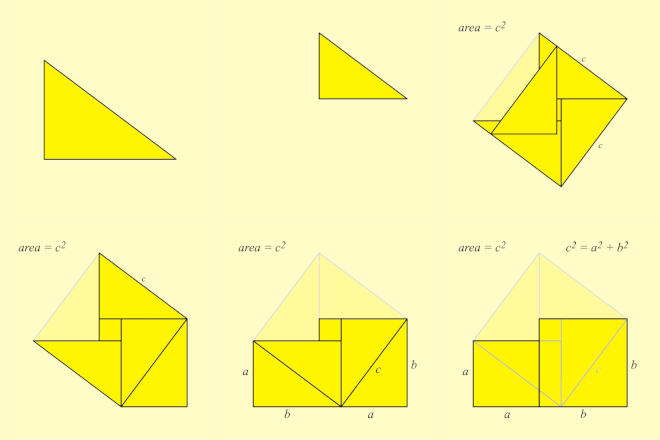
"Proof by rearrangement" [probably Pythagoras's method] avoids any algebra or calculations - it's just "drawing"... The first example is by far the simplest!











Advertisement