Thank you for the good words, HornOxx.
Oops, your profile's looking a bit empty! To help us tailor your experience, please fill in key details like your SketchUp version, skill level, operating system, and more. Update and save your info on your profile page today!
⚠️ Important | Libfredo 15.6b introduces important bugfixes for Fredo's Extensions Update
D
Offline
Posts
-
RE: Have a seat
Thank you, gentlemen. Everything old really is new again. I wouldn't mind decorating my house with any of these seats. If only I could afford them. I can barely afford Ikea--even if I bring my own Allen wrench.
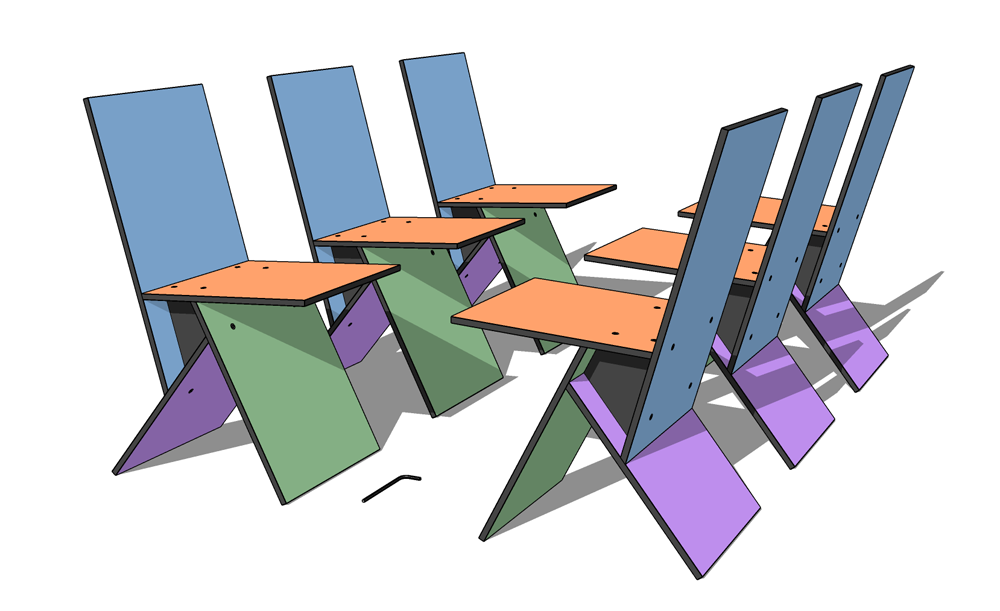 Speaking of Ikea, I modeled this chair a couple of years ago. It's early Ikea, designed by Verner Panton. It's called the "Vilbert" chair, and only about 4000 were ever made. Yes, that's an Allen wrench between the two rows of seats.
Enjoy. -
RE: Have a seat
Thank you, sir. The settee was the easiest to model. The Scandinavian Modern, the hardest; no right angles anywhere.
dh -
Have a seat
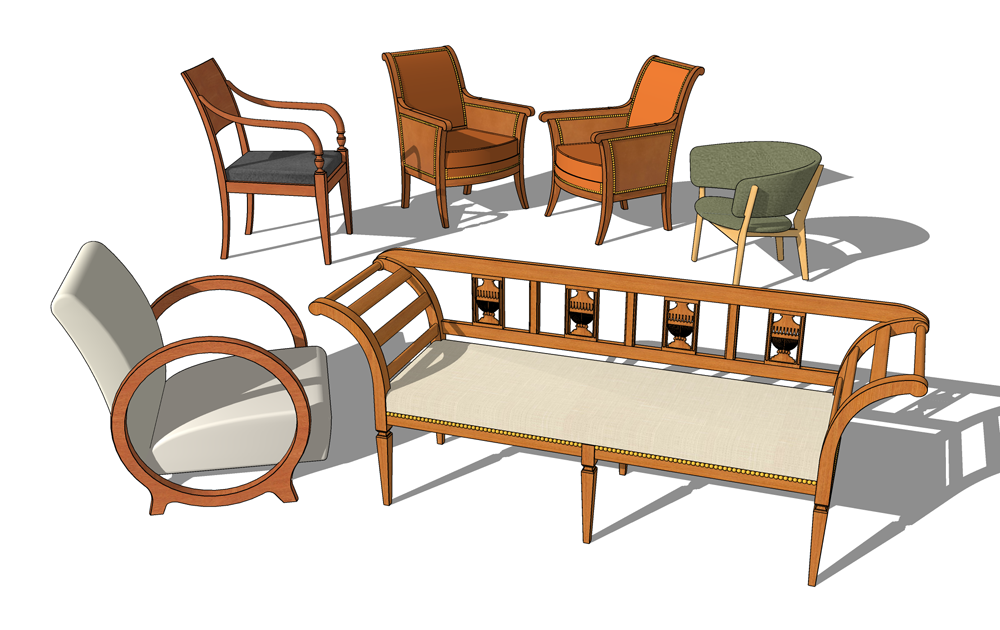 Lately, I've been attracted to chairs. All kinds of chairs, but especially chairs and other seating with some interesting curves. The ones shown here are my latest models. In the foreground is a French Art Deco armchair with circular arms by Jacques Adnet; to the right is a French settee from about 1870. In the background, from left to right: A Swedish Empire armchair from the early 19th century; a pair of French armchairs, or bergeres, from the mid-19th century; and a Scandinavian Modern armchair by the designer Nanna Ditzel.
Enjoy.
dh -
RE: Dutch Arts & Crafts Pedestals c.1905
I thought the leg joinery would be something like what you've shown. If I were making the piece, I think I'd turn turn a tenon on the leg and drill a mating hole through the half-lapped feet.
Best,
dh -
RE: Dutch Arts & Crafts Pedestals c.1905
Very nice. There's a lot going on at the base, with overlapping feet and the corner posts. What's the joinery there?
-
RE: Viennese pastry for lunch
Thanks, Tuna. It was really pretty easy. Took me less than an hour, and that includes time to eat my PB&J for lunch and to find a good brass texture.
-
RE: Viennese pastry for lunch
Thanks, Dave. Yes, those balls were part of his signature.
-
Viennese pastry for lunch
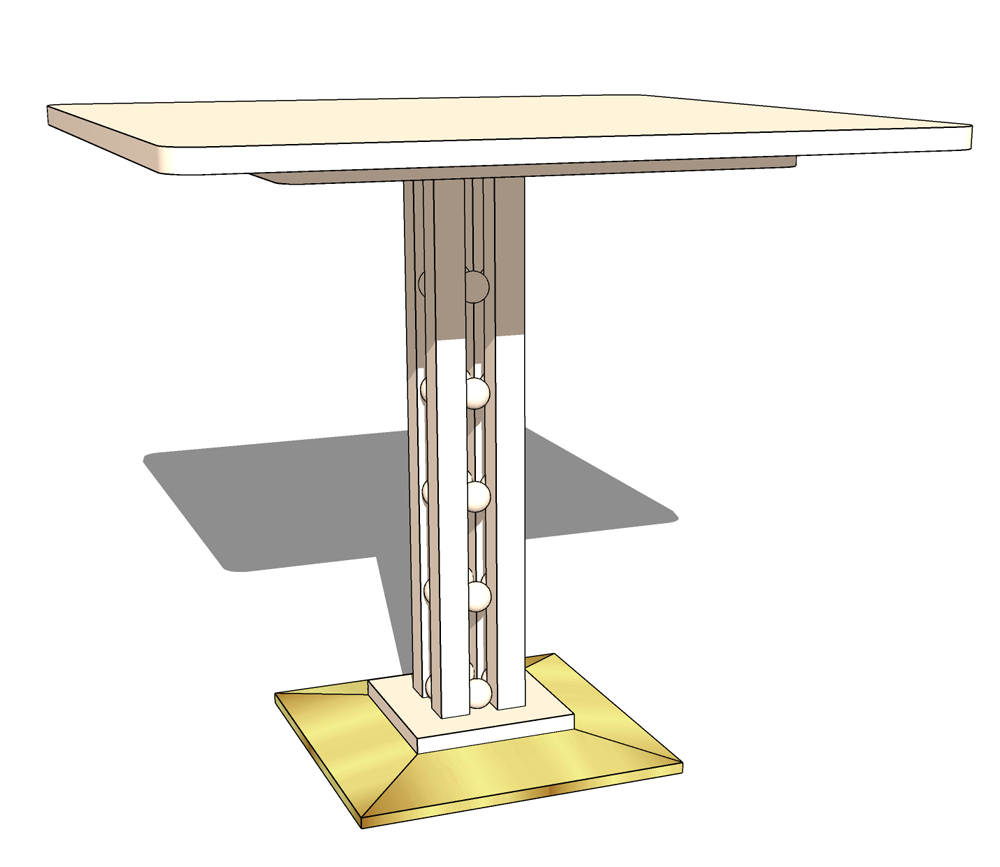 I'm slowly finishing a tricky model of an upholstered chair, so today I took a lunchtime break from the hard stuff and did a quick model of a Josef Hoffmann bistro table from 1910. The one I saw was painted off-white, but I'll bet that if I look harder I'll find the same table in black. The base is sheathed in brass.
Enjoy.
dh -
RE: Lathe Stand Legs
My memory failed me in a couple of details about the John Grass woodturning company (not woodturning studio). It used a 7.5 hp motor, not a 5-hp, and the motor replaced a steam engine.
-
RE: Lathe Stand Legs
Step away from the screw threads, sir.
However, you might want to model a #2 Morse taper in the headstock and tailstock, and add a handwheel to advance the tailstock.
I like the idea of adding a belt and wheel over the lathe.FWIW,there used to be an amazing woodturning shop in Philadelphia's Old Town: The John Grass woodturning studio. The Center for Art in Wood, which promotes woodturning and sculpture, tried mightily to save the studio but was ultimately unsuccessful. John Grass was the oldest woodturning shop in Philly, dating to the mid-19th century. Among many other things, John Grass turned all the billyclubs that the Philadelphia P.D. used. The turning studio had two floors of machinery--planers, jointers, saws, and woodturning stations. These were long benches with a headstock and a tailstock bolted to the benchtop at various intervals. Everything in the shop was belt-driven, powererd by a 5-hp motor in the basement. The motor made a fearsome racket when it was turned on, and the belts also put out quite a noise as they spun and slapped. All of this is to say that parts of the lathe that Dave R. has so beautifully modeled might have been used in one of those wodturning stations.
-
RE: Lathe Stand Legs
Wow. Great job.
It's probably a good thing that the lathe doesn't have it's own motor. You'd probably want to model all the copper windings.
-
RE: Ward Bennett chair complete
The Dave Method (invented by Dave Richards, a constant presence on this forum) is a technique for intersecting shapes without problems. It gets around a SketchUp shortcoming: The program creates a hidden network of rectangles and triangles to create surfaces. But it also has a limit, and can't fill in those hidden shapes if they are too small, something like 0.1mm. However, components in SketchUp possess a property that gets around that size limitation: A change to one component produces the same change in every instance of that component.
So here's how the Dave Method uses that property of components to foil that shortcoming in SketchUp. Let's say you want to intersect two shapes to create a cabriole leg. Make the shapes a component, make a copy of the component, and scale the copy up 100x, 1000x, or even 10,000x. Perform the intersect command and erase the waste. That will produce a clean, solid shape with no microscopic voids. Delete the scaled-up copy. The original component will also be a clean, solid shape with no microscopic voids.
The Dave Method also works with the Follow Me tool. If you want to use Follow Me to create a shape, like an elaborate table leg with lots of small beads and coves, make the profile a component, scale it up, and use Follow Me on the big copy. If you only work on the original profile, the extruded shape will almost certainly have some missing faces.
Hope this helps.
Best,
dh -
RE: 4 Beam Marking Gauge
Nice model and a super, innovative tool. You might consider inlaying a strip of brass on each arm, so that the screws holding the arms don't dig divots in the wood.
-
RE: Lathe Stand Legs
Nice. But odd that the banjo clamp rides on those rails and so can't move laterally. I'll bet this was a lathe for making furniture parts.
-
RE: Ward Bennett chair complete
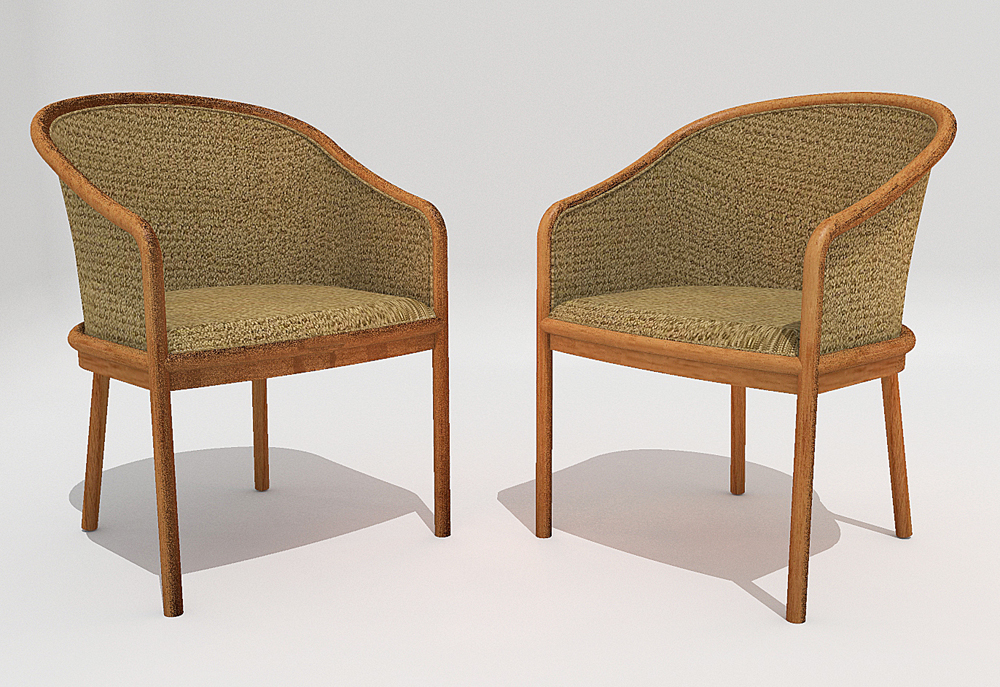 Thank you for the good words, everyone. Here's a quick render in Shaderlight. And Dave, you let your midwestern modesty show. You seem to spend about 36 hours a day on the SketchUp forum, showing the befuddled how to find the shortest path from point A to point B. The army of people you've helped would surely say that your SketchUp Sage designation is well-deserved.
Best,
dh -
Ward Bennett chair complete
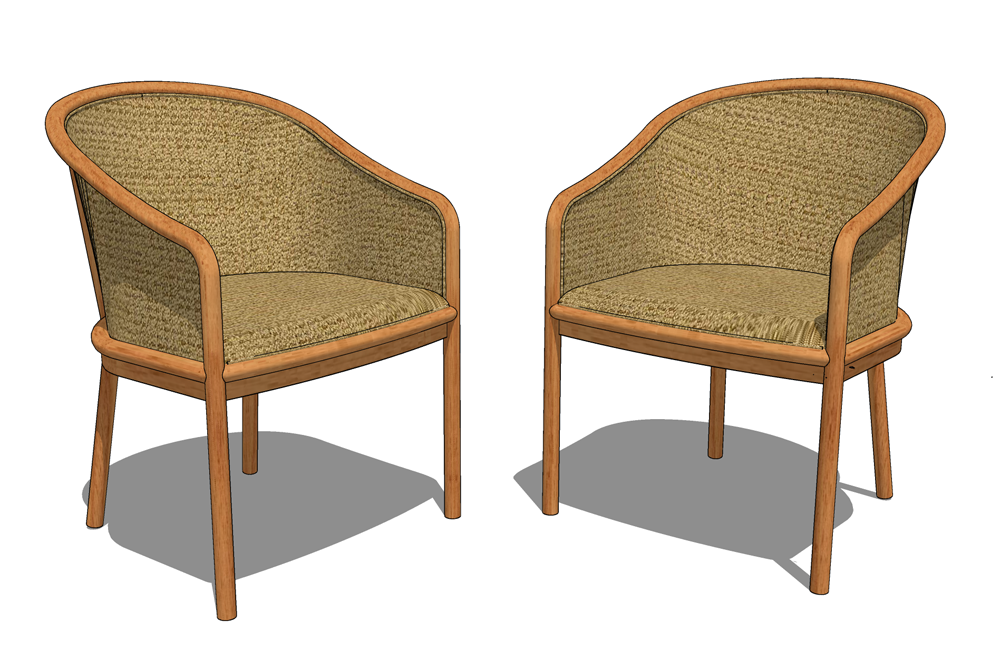 Finished the chair I previewed yesterday. I finally followed some of Dave Richards's advice to make the work much, much easier. I saved the Follow Me profiles that I used for the legs, seat frame, and back leg, and made sure that I used the Weld plugin on each profile. That made modifications much easier. Oh, and the Dave Method for creating the seat. If I hadn't done that, I'd still be filling in missing microscopic faces. No joinery, but at least I used Solid Tools to intersect the various parts.
The chair is known as the Landmark chair, one of some 150 that Ward Bennett designed. The original is still in production in many variations, available from Brickel Associates and from Herman Miller. Some have cane to fill in the back and sides; the frame is either mahogany or oak.
Enjoy.
dh -
RE: Lathe Stand Legs
 Dave,
Dave,
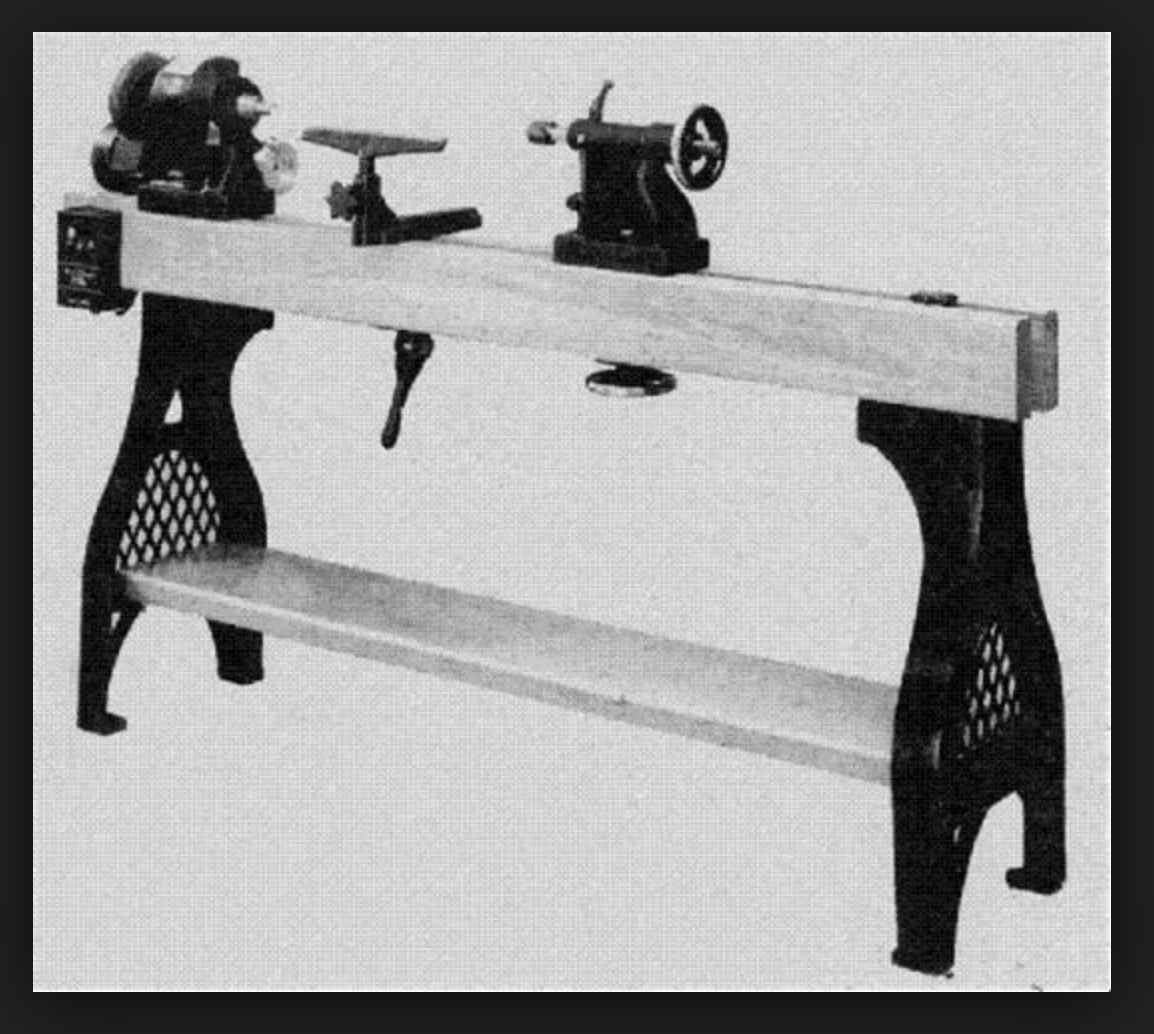
Now that you've done some warm-up, maybe you can model a Conover Lathe. Created by noted woodturner Ernie Conover and his father, the lathe was made for a good 20 years, up to the 1990s. It had cast-iron legs, banjo, and tailstock, and hardwood ways. You can still find some for sale here and there. I could probably get Ernie to provide a better image.
Best,
dh