sketchucation logo sketchucation
    • Login
    Oops, your profile's looking a bit empty! To help us tailor your experience, please fill in key details like your SketchUp version, skill level, operating system, and more. Update and save your info on your profile page today!
    ⚠️ Update | Sketchucation Tools 5.0.8 released with licensing improvements and bugfixes Download

    WebDialog parameters passed to callback cause .to_l error

    Scheduled Pinned Locked Moved Developers' Forum
    29 Posts 7 Posters 2.7k Views 7 Watching
    Loading More Posts
    • Oldest to Newest
    • Newest to Oldest
    • Most Votes
    Reply
    • Reply as topic
    Log in to reply
    This topic has been deleted. Only users with topic management privileges can see it.
    • J
      Jim
      last edited by

      It is curious, and there is a lot going on behind the scenes. This document explains some of what is going on.

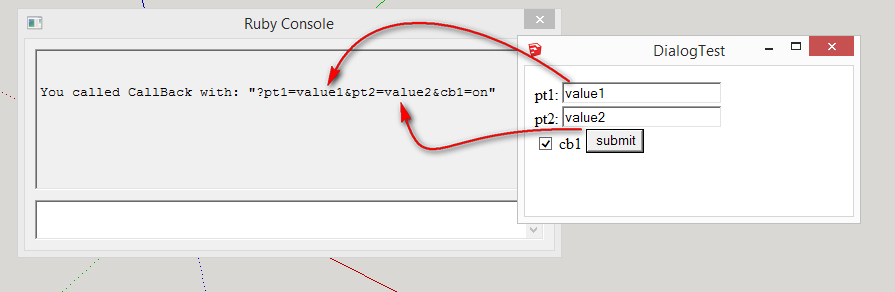
      You are relying on the WebDialog (and HTML specifications) to put together your form data. The form data is sent to the Ruby script as one string. There is a limit to the length the string may be. The browser replaces spaces with + signs and and possibly other substitutions. Form data is appended to the string in order they appear in the form with a & and a name/value pair separated by =.

      2014-11_150.png

      The problems start if you need to pass any of the symbols +, space, &, or = from the web dialog form to your Ruby script. You will find the form data difficult if not impossible to parse on the Ruby side. Here is a contrived example:
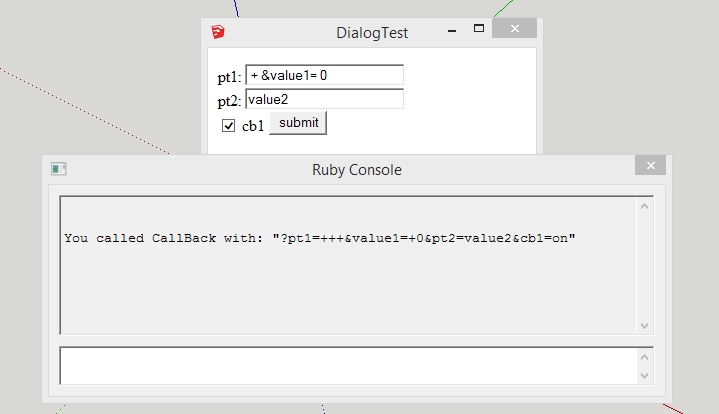
      2014-11_151.png

      Because of these limitations, most folks have adopted some alternative method of data serialization to encode the form data such as JSON or Base 64 encoding, all of which require some use of JavaScript to process the form data prior to sending it to the Ruby script.

      Hi

      1 Reply Last reply
      Reply Quote 0
      • J
        Jim
        last edited by

        @jolran said:

        How bout .to_f.to_l ?

        Careful..

        "1".to_l ==> 1.000000cm

        "1".to_f.to_l ==> 2.540000cm

        Hi

        1 Reply Last reply
        Reply Quote 0
        • jolranJ
          jolran
          last edited by

          Yes, that is a side effect. If one would take that approach...

          It may be worth to mention "1.0".to_l doesent work either..

          I think it's debatable using forms at all..
          Passing onclick events to functions gives more options parsing the strings before sending them to Ruby..

          1 Reply Last reply
          Reply Quote 0
          • D
            driven
            last edited by

            @jim said:

            ...Commas do not make good value separators because some languages use commas where we would use a decimal point in a number...

            can something like this be used to find the digit separator

                  [1.1].length == 2 ? sep = "." ; sep = ","
                  x,y,z = val.split(sep)
            

            I also found if you use to_f to clean any non digit's up on the ruby side, you break to_l

            i.e my input of 1 will become 25.4mm...

            john

            learn from the mistakes of others, you may not live long enough to make them all yourself...

            1 Reply Last reply
            Reply Quote 0
            • D
              driven
              last edited by

              @jolran said:

              It may be worth to mention "1.0".to_l doesent work either..

              "1.0".to_l 
              => 1.0mm
              
              "1.0".to_f.to_l 
              =>25.4mm
              

              I missed a couple of post...

              learn from the mistakes of others, you may not live long enough to make them all yourself...

              1 Reply Last reply
              Reply Quote 0
              • jolranJ
                jolran
                last edited by

                Ah yeah, Jim said that already.. I only looked at the code 😳

                puts "1.0".to_l still don't work for me.
                Error: #<ArgumentError: (eval):258:in `to_l': Cannot convert "1.0" to Length>

                1 Reply Last reply
                Reply Quote 0
                • D
                  driven
                  last edited by

                  @jolran
                  are you still on v8...

                  learn from the mistakes of others, you may not live long enough to make them all yourself...

                  1 Reply Last reply
                  Reply Quote 0
                  • jolranJ
                    jolran
                    last edited by

                    Yes John. Still on 8. I havent had time to test the new good stuff..

                    Btw .to_s.gsub(".", ",").to_l worked for me in the node editor. But I can't remember if I did an eval on a hash_String before running that..
                    I havent touched the JS for a while...

                    Now seeing this I wonder if I got it all wrong, it seemed to work properly 😕

                    edit: puts "1.0".to_l don't work(for me) on 2014 either. But it never has so I'm suprised you made it work. Maybe because your on Mac ?

                    Oh yeah and even how ugly it may look this works: eval("+1.0").to_s.gsub(".", ",").to_l
                    Then again I believe TS is not interested in hacks..

                    1 Reply Last reply
                    Reply Quote 0
                    • J
                      Jim
                      last edited by

                      @jolran said:

                      edit: puts "1.0".to_l don't work(for me) on 2014 either. But it never has so I'm suprised you made it work.

                      Really? Does "1,0".to_l work?

                      Hi

                      1 Reply Last reply
                      Reply Quote 0
                      • jolranJ
                        jolran
                        last edited by

                        @unknownuser said:

                        Really? Does "1,0".to_l work?

                        Yes.

                        1 Reply Last reply
                        Reply Quote 0
                        • J
                          Jim
                          last edited by

                          A begin..rescue clause can be used to test this. For a one-off:

                          
                          len = begin
                            "1,2".to_l
                          rescue
                            "1.2".to_l
                          end
                          
                          p len


                          But obviously it would be better to write a method to handle this for more cases.

                          Hi

                          1 Reply Last reply
                          Reply Quote 0
                          • jolranJ
                            jolran
                            last edited by

                            heh 😄 yeah that works to.

                            Don't know if it's prettier than a gsub, but if it works..

                            Does the code pass through transparently if no errors, or does this add overhead?

                            It might be interesting to do a speed comparing against gsub variant.

                            @unknownuser said:

                            But obviously it would be better to write a method to handle this for more cases.

                            Yeah, but sometimes one run into corners where direct evaluation is necissary.
                            Like get_element_value at some odd place where not possible to go through normal routine.

                            1 Reply Last reply
                            Reply Quote 0
                            • jiminy-billy-bobJ
                              jiminy-billy-bob
                              last edited by

                              I use this :

                              <span class="syntaxdefault"><br />def self</span><span class="syntaxkeyword">.</span><span class="syntaxdefault">decimal_separator<br />        </span><span class="syntaxstring">'1.0'</span><span class="syntaxkeyword">.</span><span class="syntaxdefault">to_l<br />        return </span><span class="syntaxstring">'.'<br /></span><span class="syntaxdefault">    rescue ArgumentError<br />        return </span><span class="syntaxstring">','<br /></span><span class="syntaxdefault">end</span><span class="syntaxcomment">#def<br /><br /></span><span class="syntaxdefault">def self</span><span class="syntaxkeyword">.</span><span class="syntaxdefault">to_l</span><span class="syntaxkeyword">(</span><span class="syntaxdefault">str</span><span class="syntaxkeyword">)<br /></span><span class="syntaxdefault">    return str</span><span class="syntaxkeyword">.</span><span class="syntaxdefault">to_s</span><span class="syntaxkeyword">.</span><span class="syntaxdefault">gsub</span><span class="syntaxkeyword">(/\</span><span class="syntaxdefault">s</span><span class="syntaxkeyword">+/,</span><span class="syntaxstring">''</span><span class="syntaxkeyword">).</span><span class="syntaxdefault">gsub</span><span class="syntaxkeyword">(/(\.|,)/,</span><span class="syntaxdefault"> self</span><span class="syntaxkeyword">.</span><span class="syntaxdefault">decimal_separator</span><span class="syntaxkeyword">).</span><span class="syntaxdefault">to_l<br />end</span><span class="syntaxcomment">#def<br />&nbsp;</span><span class="syntaxdefault"></span>
                              

                              This allows me to handle pretty much anything the users enters.

                              25% off Skatter for SketchUcation Premium Members

                              1 Reply Last reply
                              Reply Quote 0
                              • D
                                driven
                                last edited by

                                isn't it faster to test for true

                                
                                def self.decimal_separator
                                    [1.1].length ==  2  ?  ',' | '.'
                                end#def
                                

                                john

                                learn from the mistakes of others, you may not live long enough to make them all yourself...

                                1 Reply Last reply
                                Reply Quote 0
                                • jolranJ
                                  jolran
                                  last edited by

                                  Guys 👍

                                  This place is a great source of information.

                                  1 Reply Last reply
                                  Reply Quote 0
                                  • jiminy-billy-bobJ
                                    jiminy-billy-bob
                                    last edited by

                                    @driven said:

                                    isn't it faster to test for true

                                    Maybe 😄 It's widely fast enough for my use (Parsing one string at a time entered by the user)

                                    25% off Skatter for SketchUcation Premium Members

                                    1 Reply Last reply
                                    Reply Quote 0
                                    • tt_suT
                                      tt_su
                                      last edited by

                                      @driven said:

                                      isn't it faster to test for true

                                      
                                      > def self.decimal_separator
                                      >     [1.1].length ==  2  ?  ',' | '.'
                                      > end#def
                                      

                                      john

                                      You never know for sure until you profile the code. And in Ruby you get many surprises. That being said - unless you have a noticeable performance issue there is little need to pre-optimize.

                                      1 Reply Last reply
                                      Reply Quote 0
                                      • J
                                        Jim
                                        last edited by

                                        @driven said:

                                        isn't it faster to test for true

                                        
                                        > def self.decimal_separator
                                        >     [1.1].length ==  2  ?  ',' | '.'
                                        > end#def
                                        

                                        john

                                        Maybe I do not know off-hand. This is code you would run at most one time in a plugin to determine which separator to use so it isn't terribly important to optimize.

                                        The code that actually performs the conversion may need optimized especially if there are many conversions to do.

                                        Hi

                                        1 Reply Last reply
                                        Reply Quote 0
                                        • J
                                          Jim
                                          last edited by

                                          Had this idea today:

                                          
                                          separator = (1/Float(2)).to_s[1]


                                          Hi

                                          1 Reply Last reply
                                          Reply Quote 0
                                          • D
                                            driven
                                            last edited by

                                            even shorter

                                            separator = Float(1).to_s[1]

                                            

                                            learn from the mistakes of others, you may not live long enough to make them all yourself...

                                            1 Reply Last reply
                                            Reply Quote 0

                                            Hello! It looks like you're interested in this conversation, but you don't have an account yet.

                                            Getting fed up of having to scroll through the same posts each visit? When you register for an account, you'll always come back to exactly where you were before, and choose to be notified of new replies (either via email, or push notification). You'll also be able to save bookmarks and upvote posts to show your appreciation to other community members.

                                            With your input, this post could be even better 💗

                                            Register Login
                                            • 1
                                            • 2
                                            • 2 / 2
                                            • First post
                                              Last post
                                            Buy SketchPlus
                                            Buy SUbD
                                            Buy WrapR
                                            Buy eBook
                                            Buy Modelur
                                            Buy Vertex Tools
                                            Buy SketchCuisine
                                            Buy FormFonts

                                            Advertisement