Too lazy?! You had time to do a blog post http://www.finewoodworking.com/item/113435/a-transition-from-leg-to-stretcherabout making the legs
Oops, your profile's looking a bit empty! To help us tailor your experience, please fill in key details like your SketchUp version, skill level, operating system, and more. Update and save your info on your profile page today!
⚠️ Important | Libfredo 15.6b introduces important bugfixes for Fredo's Extensions Update
D
Offline
Posts
-
RE: Mid-Century Modern
-
RE: Mid-Century Modern
Dave,
Very nice, as usual. I like the finger joints for the turned-up ends on the top. To my eye, though, the long stretcher might look better if it flared slightly at each end, rather than run straight its entire length. Easy for me to say, 'cause I don't have to model the piece.
Best,
dh -
RE: A Double Chest of Drawers
Dave,
This would go well with the country hutch presently featured in a video workshop on Fine Woodworking.com.
And if I'm not mistaken, you did the plan for the hutch, too.
Best,
dh -
RE: A 'machine for sitting'
Thanks, all. Let me think about doing an animation. Interesting idea.
Best,
dh -
A 'machine for sitting'
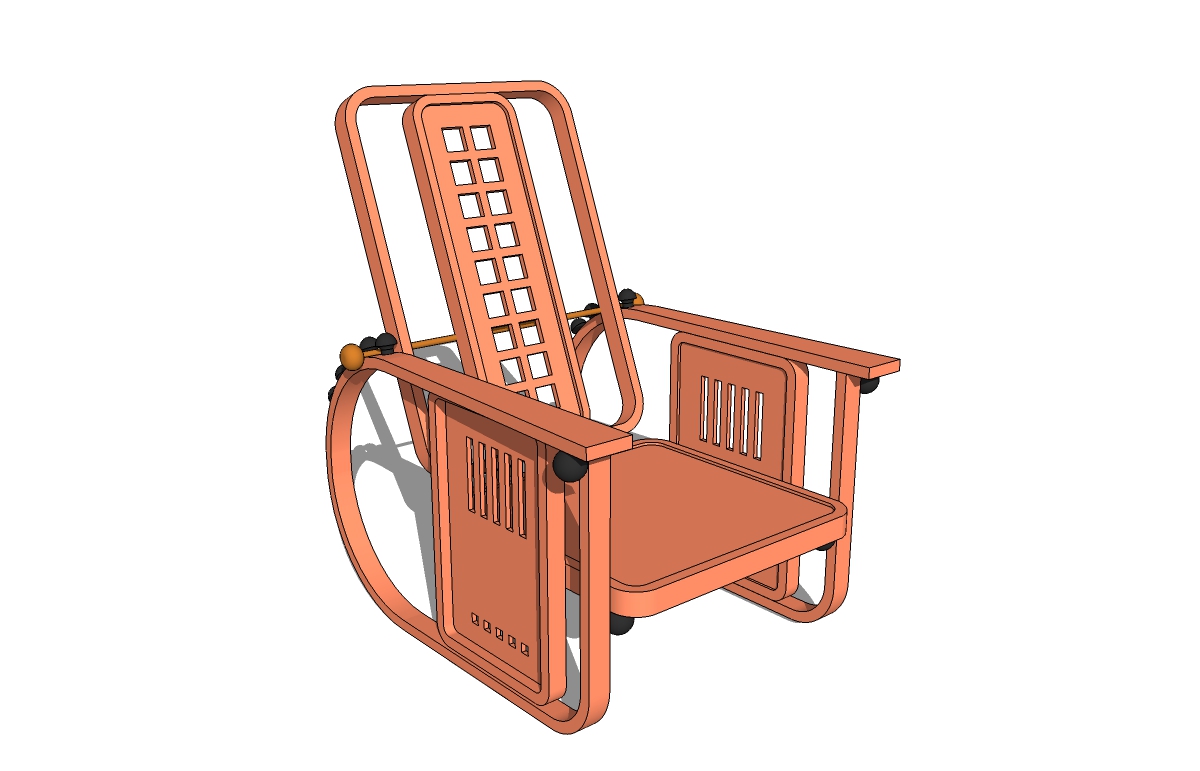 I've wanted to model this chair in SketchUp for some time. The original, called a "sitzmaschine," or machine for sitting, was designed by the influential Austrian designer Josef Hoffmann in 1905. It's essentially a Morris chair, with mushroom-shaped knobs on the curved arms to hold a metal rod that supports the back. However, I never could pin down enough key dimensions to get started.
Anyway, over the weekend I got lucky and finally found some web sites that gave me enough information to try the model.
Let me know what you think.Best,
dh -
Swedish Arts & Crafts
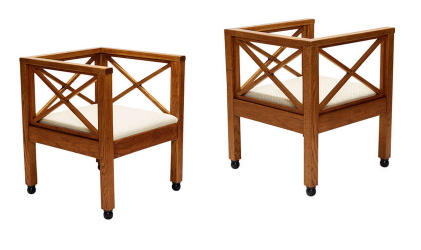 Just finished a model of an interesting chair that I spotted on the 1stdibs.com auction site. The original pair, shown in the photo, were made of oak with ebonized ball feet and wool upholstery. They date from the first decade of the 20th century. Nothing fancy here. This actually feels like a piece I could build for real. Maybe I'll double its width, scrap the upholstered seat in favor of slats, and make this into an outdoor bench.
Let me know what you think.
Best,
dh -
RE: Pinwheel table
Dave,
I appreciate the offer, but convincing her of the value of a Domino would be completely futile.
Best,
dh -
RE: Pinwheel table
Dave, Steve,
Good suggestions; thanks. If I were building this piece for real (and if I did get a Domino for a July 4 present), I think I'd try the auxiliary fence to cut the mortises.
Best,
dh -
RE: Pinwheel table
Dave,
Thanks for the good words. You're right about a router jig and spiral upcut bit, but a Festool Domino is way cooler. Too bad I didn't lobby for one for Father's Day.And, now that I think about it, the original table was probably assembled with dowels.
Best,
dh -
Pinwheel table
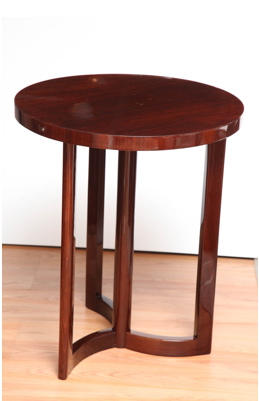 art deco pinwheel table.skpI was cruising the 1stdibs auction site tonight, because I wasn't that interested in what was on TV. Came across this Art Deco side table; placing tenons on the upper and lower rails was a moderate challenge. If I owned a Festool Domino, I might try to build one of these tables for real.
dh -
RE: Compound angle Tool
For Mac users like me, who don't download a lot from the PlugIn Store, could you post some instructions on how to install your plug-in?
Many thanks,
dh -
RE: Banca Desk
Dave has a point. Steaming the components of the legs would reduce the stresses where the four pieces join, as well as around the box joints.
dh -
RE: Banca Desk
Dave,
More on those legs. If the legs are four pieces glued and bent, the glue joint will be in tension. Wonder how long it takes for one of those joints to fail? If the leg is split, then the joint where the legs intersect the box jointed stretchers is in compression, so it might be stronger in the long term.
None of this has anything to do with SketchUp, of course. I'm just curious. Yours is a nice model and a nice render.
Best,
dh -
RE: Banca Desk
Cool.
The guy has nerve, cutting very long tongues for the box joints from pine. The table also seems to have one piece of interesting engineering: It looks as if he splits the pieces for the legs, then spreads those thin pieces to wrap around the box joint.
Thanks for this.
dh -
RE: Cutting letters
I seem to recall that someone once did a tutorial on placing text on a wine bottle in SketchUp. I wasn't able to find it, but I believe it went something like this:
Set up your curved surface (like a really large-diameter cylinder), but don't make it a component.
Create the text you want to apply to the curved surface using the 3D text tool. Align it with the curved surface so the text is centered on the diameter of the curve, and at the desired height.
Use Push/Pull to push each letter toward the curve until it intersects.
When all the letters have been extruded in this way, select everything and run an Intersect with Model command. Erase the waste (the extruded letters, that is). You should be left with the outline of the letters on the curved surface. Now you can make the curve a component.I gave this a quick try and it seemed to work. See the attached SU file. Hope it helps.
Best,
dh
-
RE: Latest project
Mrossk,
It's good to know that someone is actually reading those blogs.
I may do more of those miniature turnings. They are fun.
Best,
dh -
RE: Latest project
Very fine piece indeed.
Swiss Pear is also a wonderful wood for turning and carving.I recently turned a small bowl from the wood; it's a pale yellow now, but I expect it to darken to a lovely cinnamon brown.
Best,
dh -
RE: Work in Progress
Many thanks, Dave and pbacot.
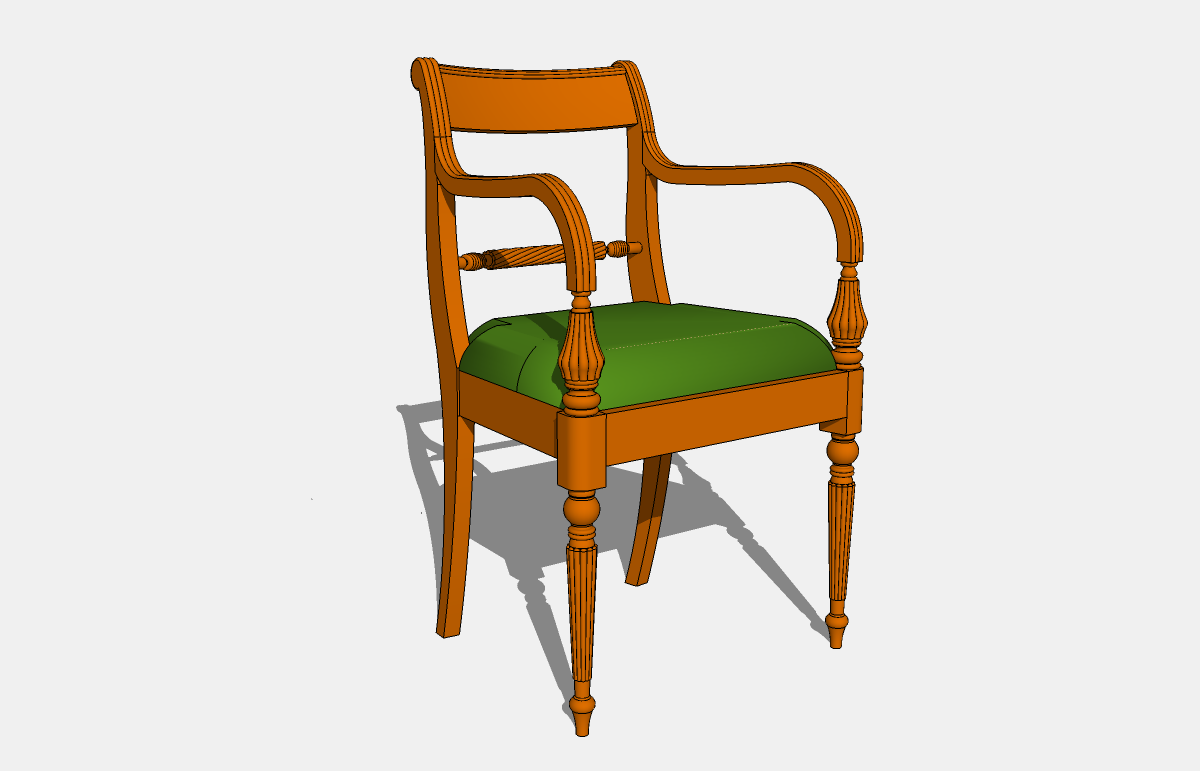
In rereading the 1stdibs.com listing for this chair, I learned that it's also known as a Trafalgar chair, and that the twisted back support is supposed to represent rope, to commemorate Nelson's victory in the Battle of Trafalgar. The original set of chairs was made between 1815 and 1825.
Best,
dh
 Finis!