Find the global position of a Vertex in a Group/Component
-
@thomthom said:
SU changes the co-ordiates when you open a group/component. When a group or component is open SU returns global co-ordinates for the entities in that context.
It seems Tim Toady is more prevalent that i had originally feared!

PS: Before some hot shot notices i made a mistake in accessing the origin using
collection..transformation[-1]Since the transformation is a 16 element array an NOT a 4 element array of 4 element sub arrays that code will only return the last float.
-
@thomthom said:
Only way is to map the whole model, going from Model and up. Which is just a brute force way to do it.

Not really true. Its certainly non-trivial but LightUp does it
 . ie LightUp needs to find the transform of every instance of a Component called PointLightSource. Clearly starting at the top and walking down is "one way" buts its incredibly inefficient. Better is to get each instance (trivial) then work your way back up concatenating transforms as you go - and dealing with the fact that there can be many instances of Components as thomthom points out. Took a fair amount of head scratching but its all in lightcache.rb if you want to take a butchers.
Its invoked by
list = LightCache.flat(LightCache.walk(ent, ent.transformation))which gives you back a list of transforms.Adam
-
Very interesting Adam. I'm glad to be proven wrong.
I will for sure poke about that code of yours. Is it ok with you if I adapt it to a generic method and add it to my generic library shared between my plugins?
-
@adamb said:
Clearly starting at the top and walking down is "one way" buts its incredibly inefficient. Better is to get each instance (trivial) then work your way back up concatenating transforms as you go - and dealing with the fact that there can be many instances of Components as thomthom points out. Adam
Exactly what I'm trying to do! Thanks, Adam, I'll check this out.
-
OK, I think I'm getting a clearer picture now.
 Let me sum it up to make sure.
Since we can have multiple instances of a Group/Component, there is a One-to-Many relationship between a Vertex and Transformations:
Vertex->ComponentDefinition->ComponentInstances->ComponentInstance->Transformation
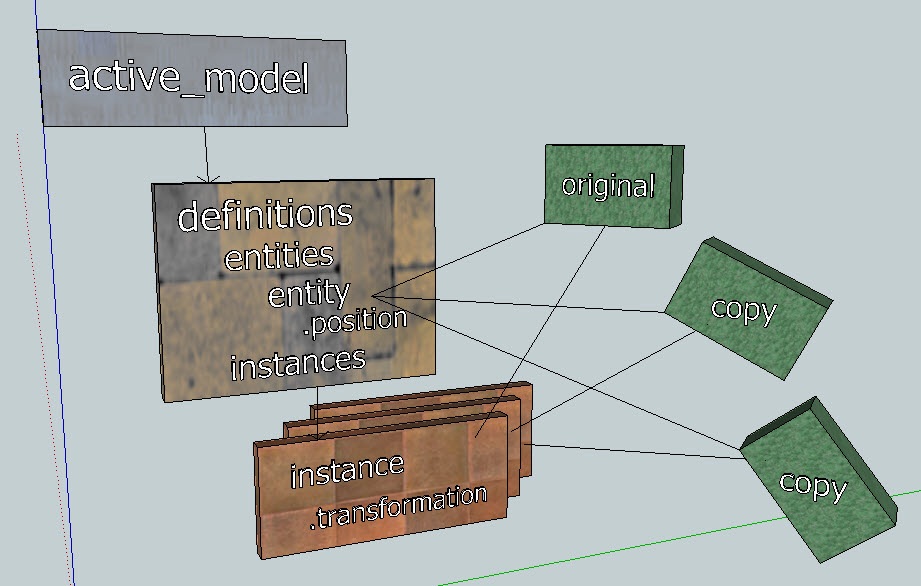
Therefore, to get the global position of a Vertex you need BOTH the Vertex (which is in ComponentDefinition) AND the specific ComponentInstance you are evaluating. From there you can walk UP the hierarchy of ComponentInstances and get their Transformations to apply to the Vertex.So in Ruby we have:
Sketchup.active_model #top of model
Sketchup.active_model.definitions #returns DefinitionList
Sketchup.active_model.definitions[n] #returns ComponentDefinition[n] from array
Sketchup.active_model.definitions[n].instances[n] #returns ComponentInstance[n] from arrayYou can get a quick picture of this in SU with:
Sketchup.active_model.definitions.each {|definition| puts "#{definition} contains #{definition.instances}\n" } -
Adam, that code returns the transformation of all the copies of that instance? But no way to track back a single path to the model, like you get with PickHelper?
-
@gbabcock said:
From there you can walk UP the hierarchy of ComponentInstances
Well, not quite...
The Parent of a ComponentInstance is a ComponentDefinition, which can exist in more than one ComponentInstance (for example, if you have multiple instances of a Component that has nested Components). So you can't even walk up the hierarchy of ComponentInstances.

But walking down works well! My use case is where I have selected a Group/Component (but not opened it) and need the global position of every Vertex. With limited testing performed, this code seems to give an accurate position report:
#get vertices
def Start
	#get vertices
	verts=[] #initialize vertices array
	trans_h=[] #initialize transformation array use to store hierarchy of transformations
	verts=createVerticesArray(sel,trans_h,verts)
end

def createVerticesArray(sel,trans_h,verts)
	sel.each{|ent|
		if (ent.is_a? Sketchup;;Group) || (ent.is_a? Sketchup;;ComponentInstance)
			trans_h.push(ent.transformation) #push the Group/Component tranformation onto the array
			ents=ent.definition.entities #get the entities in this Group/Component instance
			verts=createVerticesArray(ents, trans_h, verts) #recurse
		elsif (ent.is_a? Sketchup;;Edge)
			ent.vertices.each{|vert| #begin analysis of vertices in this edge
					puts vert if @debugFFD
				#get global position of the vertex by applying the hierarchy of transformations
				v_gpos=vert.position #returns local Point3d position of vertex
					puts v_gpos if @debugFFD
				flat_t=flatten(trans_h) #get the flattened transformation for the hierarchy
					puts flat_t if @debugFFD
				v_gpos.transform! flat_t #transform the vertex to get the global position
				vert.set_attribute("vert","gpos",v_gpos)
				verts.push(vert)
			}
		end
	}
	#verts now contains redundant verts. remove duplicates.
	verts.uniq!
	return verts
end

#thanks to Adam for the idea!
def flatten(trans_h) #returns a flattened transformation from an array of transformations for the instance hierarchy
	flat_t=Geom;;Transformation.new #create an entity transformation object

	#apply the hierarchy of transformations to the entity transformation
	trans_h.each{|t|
		flat_t=flat_t* t
	}
	return flat_t
end
It performs well too, though I'm sure it could be improved. I have used it on a component with ~8400 entities and 1720 vertices, and get the results back in 0.25 seconds consistently.
Glenn
-
Interesting thread. I'm trying to do figure out how to apply transformations to SU mesh objects for exporting. The object.transform! method seems to only perform rotation and scaling but not translation (e.g. the delta movement along the x, y, and z axis). I see that the transform matrix does indeed contain the translation values in the last row (row 4) of the matrix. Why doesn't the transform! method also perform the translation? Is this a bug or a feature?
-
Never had any problems with translation and
.tranform!.
Maybe post a code snippet? (though in a new thread - as we're moving towards a new topic) -
one small correction to the code posted by Glenn: after calling createVerticesArray on line 14, add the line:
trans_h.pop
otherwise, if there are multiple sub-components in the entities collection, you will take into account the transformation of any entity that came before.
Otherwise, great code, very useful.
Thanks!
--
Karen




Advertisement